
Credit Explained: A Complete Guide to Scores, Reports, and Cards
One authoritative resource covering how credit scoring works, what lenders see, how cards factor in, and how to manage your credit confidently over time.
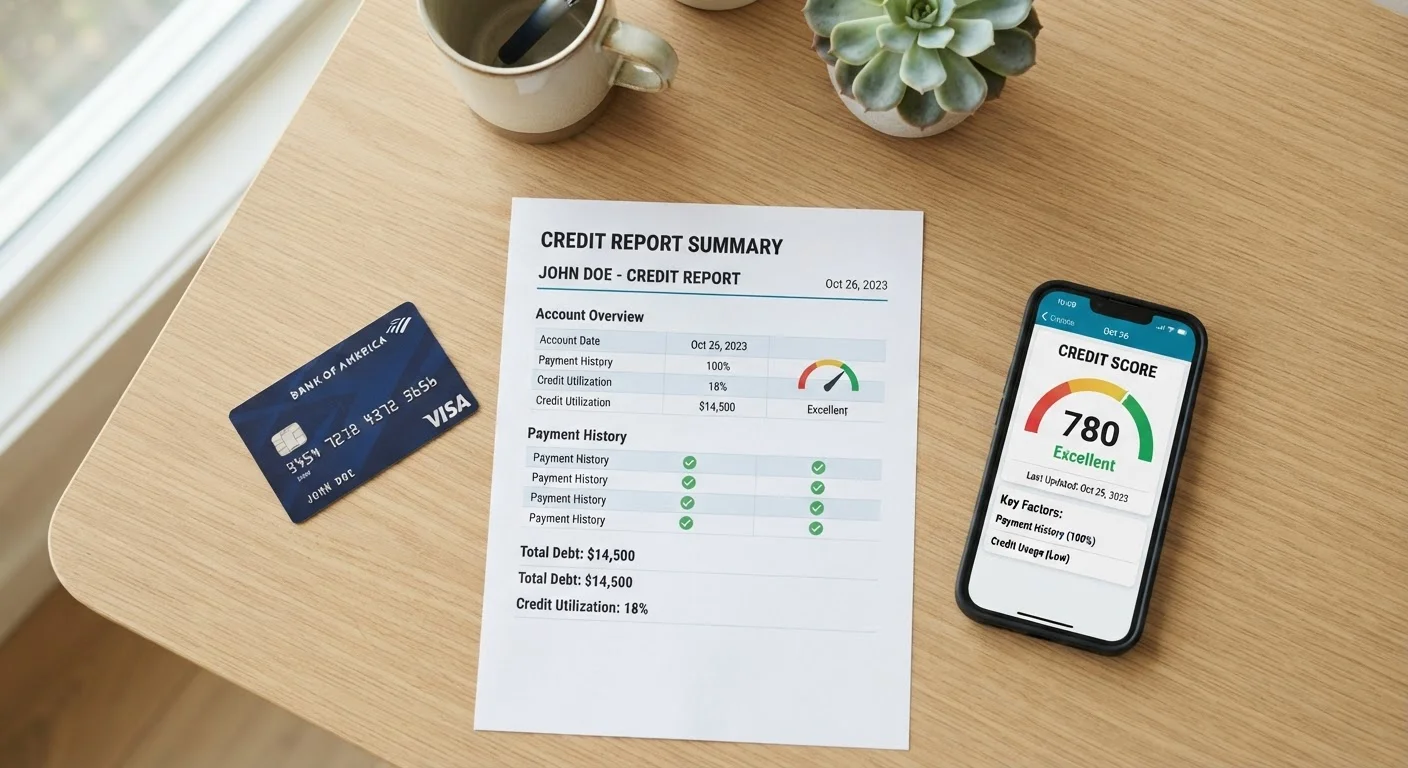
Photo: SummarizedReads.net | Just Read It! editorial
—— In This Article
Key Takeaways
- Your FICO score is calculated from five factors; payment history carries the most weight at 35%.
- You are entitled to one free credit report per year from each of the three major bureaus.
- Keeping your credit utilization below 30% meaningfully improves your score over time.
- Errors on your credit report can be disputed and corrected under federal law.
- Building credit is a long-term habit, not a one-time fix.
What Is Credit and Why Does It Matter?
Credit is a lender's assessment of your ability and willingness to repay borrowed money. When you apply for a mortgage, auto loan, apartment lease, or even a utility account, the other party typically checks your credit profile to decide whether to extend an offer - and on what terms.
A strong credit profile can mean lower interest rates, higher borrowing limits, and smoother approvals. A weak one can mean higher costs or outright rejections. Importantly, your credit history also influences things you might not expect, such as cell phone contracts and, in some states, certain employer background checks.
For budget-conscious consumers, understanding how credit works isn't just academic - it directly affects how much everyday borrowing costs you. Managing it well is one of the highest-leverage financial habits you can build. For a broader view of managing debt alongside your savings goals, see our Saving & Debt hub.
How Credit Scores Are Calculated
The most widely used scoring model in the US is the FICO score, which runs from 300 to 850. VantageScore is another common model, and while it uses the same range, its weightings differ slightly. Most lenders rely primarily on FICO.
35%
Weight of payment history in FICO score
According to FICO's publicly published scoring model breakdown, on-time payments are the single largest factor in your score.
300-850
FICO score range
Scores at or above 670 are generally considered good by most mainstream lenders, according to FICO's published tier definitions.
1 in 5
Consumers with a credit report error
A Federal Trade Commission study found that roughly one in five consumers had an error on at least one credit report that could affect their score.
FICO scores are built from five categories:
- Payment history (35%): Whether you've paid bills on time. A single 30-day late payment can noticeably lower your score.
- Amounts owed / credit utilization (30%): The ratio of your current balances to your total available credit. Lower is better.
- Length of credit history (15%): How long your accounts have been open. Older accounts help.
- Credit mix (10%): A combination of revolving credit (cards) and installment loans (auto, mortgage) is viewed favorably.
- New credit (10%): Recent applications for new credit generate hard inquiries, which can temporarily dip your score.
Scores are generally grouped into tiers: below 580 is considered poor, 580-669 fair, 670-739 good, 740-799 very good, and 800 and above exceptional.
Check your credit score through your bank or card issuer's free monitoring tool before you apply for any new credit - many institutions offer this at no cost, and it gives you a realistic baseline without triggering a hard inquiry.
Knowing your score tier in advance lets you target products you're likely to qualify for, reducing unnecessary hard inquiries that can temporarily lower your score.
If you're rate-shopping for a mortgage or auto loan, submit all applications within a 14-to-45-day window so scoring models consolidate them into a single inquiry.
FICO and VantageScore both recognize rate-shopping behavior and typically treat multiple inquiries for the same loan type within a short window as one event, minimizing the score impact.
Reading Your Credit Report
Your credit report is the underlying document that scoring models draw from. It is maintained separately by three major bureaus: Equifax, Experian, and TransUnion. Because lenders don't always report to all three, your reports can differ - and so can your scores.
Under federal law (the Fair Credit Reporting Act), you are entitled to one free report per year from each bureau via AnnualCreditReport.com, the only federally authorized source. During certain periods, such as following the COVID-19 pandemic, free weekly access has been extended - check the site for current availability.
AnnualCreditReport.com Is the Official Source
Many sites claim to offer free credit reports, but AnnualCreditReport.com is the only site federally mandated under the Fair Credit Reporting Act. Other sites may charge fees or require a subscription after an initial free period. Always verify the URL before entering personal information.
When reviewing your report, focus on four areas:
- Personal information: Name, address, and employer details. Errors here can be a sign of identity mix-ups.
- Account history: Open and closed accounts, balances, and payment history. Confirm every account is one you actually opened.
- Inquiries: Hard inquiries from credit applications and soft inquiries from background checks or pre-approvals. Only hard inquiries affect your score.
- Public records and collections: Judgments or accounts sent to collections. These have significant negative weight.
If you find an error, you have the right to dispute it with the bureau in writing. The bureau is generally required to investigate within 30 days and correct or remove inaccurate information.
How Credit Cards Affect Your Score
Credit cards are a double-edged tool. Used thoughtfully, they are one of the most effective ways to build a strong credit profile. Used carelessly, they can erode it quickly.
The biggest lever is credit utilization - your card balances divided by your total credit limits. If you carry a $1,500 balance on a $5,000 limit, your utilization is 30%. Most financial guidance suggests keeping this figure below 30%, with under 10% typically associated with the strongest scores. Importantly, utilization is usually calculated from the balance reported on your statement date, not your payment date - so paying your balance before your statement closes can reduce the reported figure.
Pay Before Your Statement Closes
Your card issuer typically reports your balance to the credit bureaus on your statement closing date, not your payment due date. Paying down your balance before the statement closes means a lower balance gets reported, which directly reduces your reported utilization ratio. This one habit can noticeably improve your score over several billing cycles.
Opening new credit card accounts adds to your available credit (helpful for utilization) but also generates a hard inquiry and lowers the average age of your accounts. Closing old accounts has the opposite effect - it reduces your available credit and can shorten your credit history length. Neither action is automatically good or bad; context matters.
Paying at least the minimum amount due by the due date every month is non-negotiable for protecting your payment history score. Carrying a balance incurs interest; it does not help your score.
Building and Repairing Your Credit
If you're starting from scratch or recovering from past credit problems, the core approach is the same: demonstrate reliable repayment behavior consistently over time. There is no shortcut.
Common starting points include:
- Secured credit cards: You deposit a sum that becomes your credit limit. Use it for small purchases and pay the balance in full monthly.
- Credit-builder loans: Offered by some credit unions and community banks, these are specifically designed to establish a payment history.
- Becoming an authorized user: A family member or trusted friend adds you to an existing account. Their positive payment history can appear on your report.
For those repairing credit, addressing delinquent accounts is a priority. Bringing accounts current, negotiating payment plans, or resolving collections (and verifying they're updated accurately in your report afterward) are constructive steps. Be wary of companies that promise rapid score improvements - no third party can legally remove accurate negative information before its natural expiration, which is typically seven years for most negative items and ten for Chapter 7 bankruptcy.
The Saving & Debt hub covers strategies for tackling debt that may be weighing down your credit profile.
Accurate Negatives Cannot Be Removed Early
Legitimate negative items - missed payments, collections, charge-offs - remain on your credit report for up to seven years under federal law, regardless of whether you pay the debt off. Paying a collection account may improve your overall financial standing and some newer scoring models treat it more favorably, but it does not automatically remove the entry. Focus on building positive history rather than chasing removal of accurate records.
Common Credit Mistakes to Avoid
Even consumers who understand credit basics can stumble on avoidable errors. Here are the most consequential ones:
- Missing payments: Even one missed payment can stay on your report for seven years. Set up autopay for at least the minimum to prevent this.
- Maxing out cards: High utilization is one of the fastest ways to drop your score, even temporarily.
- Applying for too much credit at once: Multiple hard inquiries in a short period signal financial stress to lenders. Exception: rate-shopping for mortgages or auto loans within a short window (typically 14-45 days) is usually treated as a single inquiry by scoring models.
- Ignoring your report: Errors and fraudulent accounts can sit unnoticed for years. Regular review is a basic form of financial hygiene.
- Closing your oldest card: Unless the card carries a fee that outweighs its benefit, keeping older accounts open preserves both your credit history length and your available credit.
This article is for general informational and educational purposes only and does not constitute personalized financial or legal advice. Consult a qualified financial adviser or credit counselor for guidance specific to your situation.

Finance Editorial Team
Finance Editorial Team is the collective byline for our editorial team and contributor network. Articles published under this byline or an editorial pen name are researched, written, and reviewed according to our editorial standards for clarity, consistency, and independence before publication.
View author profile