
The Real Trade-Offs of Choosing a High Deductible Auto Insurance Plan
A higher deductible lowers your premium, but it shifts more financial risk to you. Weigh the genuine advantages and drawbacks before deciding.
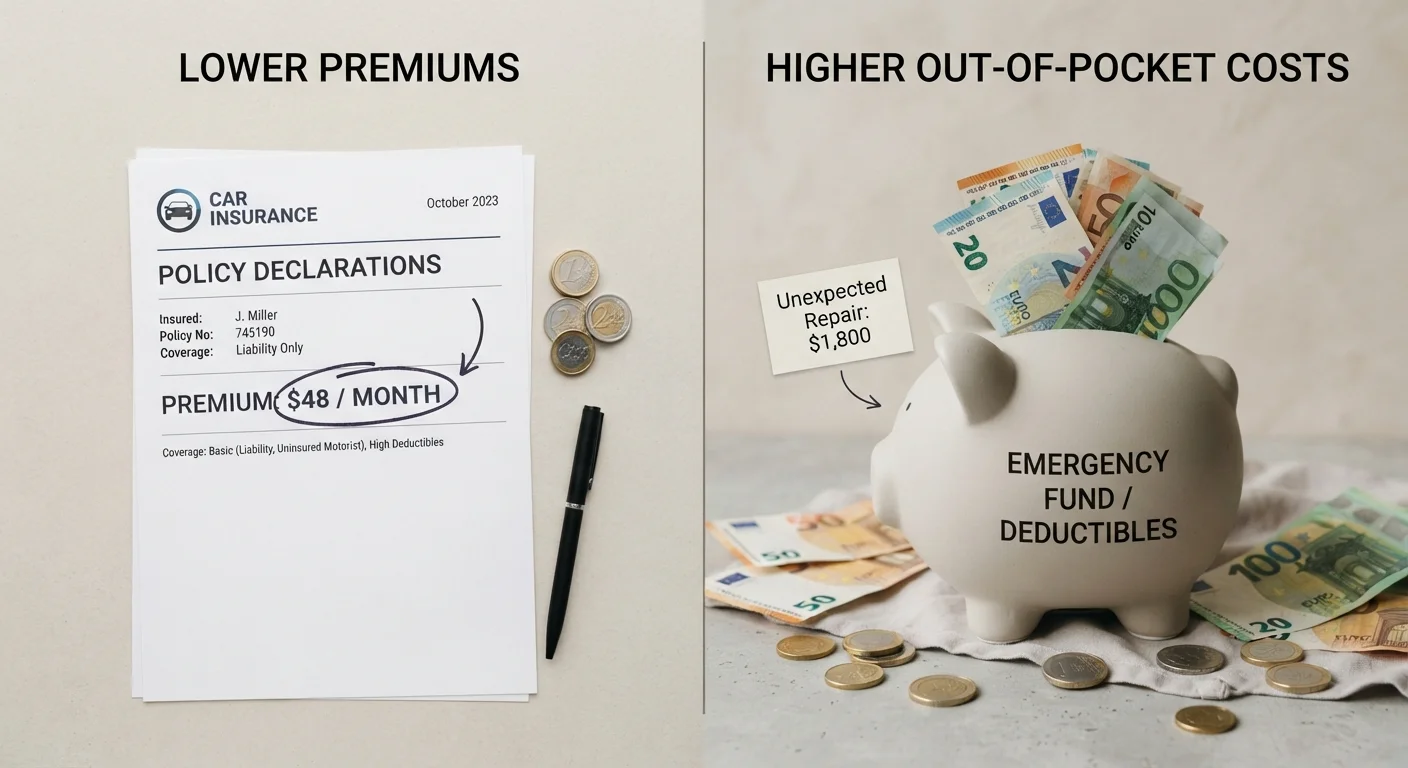
Photo: SummarizedReads.net | Just Read It! editorial
—— In This Article
Key Takeaways
- A higher deductible directly reduces your monthly or annual premium, often by a meaningful amount.
- You bear more out-of-pocket cost every time you file a claim under a high-deductible plan.
- This strategy works best when you rarely file claims and have savings to cover the deductible.
- Your vehicle's current market value should influence how high a deductible you choose.
- Running a break-even calculation helps determine whether the premium savings justify the added risk.
Lower monthly or annual premium payments
Insurers reduce your premium when you take on a higher deductible because you're absorbing more of the first-loss risk. This can free up meaningful budget room each month.
Potential long-term savings for safe drivers
Drivers who go multiple years without filing a claim can accumulate premium savings that well exceed the higher deductible amount, making this a net positive over time.
Discourages small, unnecessary claims
Filing minor claims can raise future premiums. A high deductible naturally encourages handling small repairs out of pocket, which can preserve your claims-free discount over time.
Premium savings can be redirected to an emergency fund
The money saved on premiums can be set aside in a dedicated savings account, effectively self-funding the higher deductible while building broader financial resilience.
Significant out-of-pocket cost after each claim
Every covered incident requires you to pay the full deductible before insurance kicks in. A $1,500 deductible can be a serious financial strain if the funds aren't already set aside.
Break-even period can be long
If you file a claim in the first year or two, the premium savings may not yet offset the higher deductible you owe, leaving you worse off financially than with a lower deductible plan.
May conflict with lender or lease requirements
Financing or leasing agreements often cap how high a deductible you can carry, meaning your options may be more limited than you realize when you hold a loan on the vehicle.
Higher risk on low-value vehicles
If your car's market value is close to or below your deductible, a total loss payout may barely cover what you owe out of pocket, undermining the financial rationale for carrying comprehensive or collision coverage at all.
What a High Deductible Actually Means
Your deductible is the amount you pay out of pocket before your insurer covers the remainder of a covered claim. If your deductible is $1,000 and you suffer $3,500 in collision damage, you pay the first $1,000 and your insurer pays $2,500. A high deductible generally refers to amounts above the common $500 baseline - typically $1,000, $1,500, or higher.
For a plain-language explanation of how deductibles interact with other policy terms, see our auto insurance glossary covering the concepts you'll encounter in your policy documents.
The core trade-off is straightforward: accept more financial exposure per incident and pay less every month. Whether that exchange makes sense depends entirely on your personal finances and driving habits.
Deductibles Apply Per Claim, Not Per Year
Unlike health insurance, where an annual deductible resets each year and accumulates across multiple events, auto insurance deductibles apply individually to each separate claim. If you file two collision claims in one year, you pay the deductible twice. This distinction matters when assessing total potential out-of-pocket exposure, particularly for drivers in high-risk environments or areas prone to weather events.
The Genuine Advantages
There are solid, practical reasons drivers choose higher deductibles - and they go beyond simply wanting a lower bill.
Lower monthly or annual premium payments
Insurers reduce your premium when you take on a higher deductible because you're absorbing more of the first-loss risk. This can free up meaningful budget room each month.
Potential long-term savings for safe drivers
Drivers who go multiple years without filing a claim can accumulate premium savings that well exceed the higher deductible amount, making this a net positive over time.
Discourages small, unnecessary claims
Filing minor claims can raise future premiums. A high deductible naturally encourages handling small repairs out of pocket, which can preserve your claims-free discount over time.
Premium savings can be redirected to an emergency fund
The money saved on premiums can be set aside in a dedicated savings account, effectively self-funding the higher deductible while building broader financial resilience.
The premium reduction is the most immediate benefit. Insurers price deductibles as a risk-sharing mechanism: the more you agree to absorb, the less exposure the insurer carries, and that reduction is reflected in your rate. The exact savings vary by insurer, location, driving history, and vehicle, so compare actual quotes rather than relying on general estimates.
For drivers who go years without filing a claim, the accumulated premium savings can comfortably exceed the higher deductible amount. If you want to understand all the variables shaping your rate, our article on auto insurance premium factors covers the full picture.
The Real Disadvantages
The drawbacks are concrete, not hypothetical. Every driver who chooses a high deductible should understand them clearly before signing.
Significant out-of-pocket cost after each claim
Every covered incident requires you to pay the full deductible before insurance kicks in. A $1,500 deductible can be a serious financial strain if the funds aren't already set aside.
Break-even period can be long
If you file a claim in the first year or two, the premium savings may not yet offset the higher deductible you owe, leaving you worse off financially than with a lower deductible plan.
May conflict with lender or lease requirements
Financing or leasing agreements often cap how high a deductible you can carry, meaning your options may be more limited than you realize when you hold a loan on the vehicle.
Higher risk on low-value vehicles
If your car's market value is close to or below your deductible, a total loss payout may barely cover what you owe out of pocket, undermining the financial rationale for carrying comprehensive or collision coverage at all.
The risk is most acute for drivers who don't keep liquid savings. If a covered accident occurs and the deductible isn't readily available, the plan that was supposed to save money can create an immediate financial crisis. Separately, a high deductible can also discourage filing small but legitimate claims - meaning you effectively self-insure below a threshold you may not have consciously chosen. Our auto insurance pitfall guide explores other coverage gaps that often go unnoticed.
How to Run a Simple Break-Even Analysis
Before committing to a higher deductible, compare the annual premium savings against the additional deductible amount you'd owe if you filed one claim per year.
- Get two quotes - one at your current deductible and one at the higher option you're considering.
- Calculate the annual savings - subtract the higher-deductible premium from your current premium.
- Divide the deductible difference by the annual savings - this tells you how many claim-free years you need to break even.
For example, if raising your deductible from $500 to $1,000 saves $150 per year, you need roughly 3.3 claim-free years to recover that $500 gap. If your driving history suggests that's realistic, the higher deductible may serve you well.
$500-$1,000
Typical deductible range for US drivers
According to the Insurance Information Institute, $500 is among the most common deductible choices, with $1,000 representing a frequently cited step-up that noticeably lowers premiums.
~1 in 8
US drivers who file a collision claim annually
Industry data suggests roughly one in eight insured drivers files a collision claim in a given year, a useful baseline when estimating personal claim probability.
Also factor in your vehicle's value. High deductibles on older, lower-value vehicles can push you into a situation where a total-loss payout barely clears your deductible - a scenario worth modeling before you decide. For context on how vehicle age and value affect your overall insurance strategy, see our comparison of full coverage vs. minimum coverage.
Who Should - and Shouldn't - Consider This Approach
A high-deductible plan is not universally appropriate, and the right choice depends on circumstances that are specific to each driver.
It may be a reasonable fit if you:
- Have driven claim-free for several years and expect that pattern to continue
- Maintain liquid savings equal to or greater than your chosen deductible
- Drive an older vehicle whose market value makes high-level coverage less cost-efficient
- Are comfortable self-insuring minor incidents rather than filing small claims
It is less appropriate if you:
- Would struggle to cover a $1,000+ expense on short notice
- Have a recent accident or violation on your record that suggests elevated claim risk
- Drive a newer or financed vehicle - lenders often set maximum allowable deductibles in your loan terms
If you're also navigating the question of whether to buy new or used, your deductible decision is connected - a newer financed vehicle changes the equation significantly. Our article on new car vs. used car trade-offs walks through those linked considerations.
This article provides general information about auto insurance concepts and is not personalized financial or insurance advice. Policy terms, premiums, and coverage vary by insurer, state, and individual circumstances. Consult a licensed insurance agent or adviser for guidance specific to your situation.

Auto Editorial Team
Auto Editorial Team is the collective byline for our editorial team and contributor network. Articles published under this byline or an editorial pen name are researched, written, and reviewed according to our editorial standards for clarity, consistency, and independence before publication.
View author profile