
What Your Credit Score Is Actually Measuring
Credit scores can feel mysterious. Here's a plain-language breakdown of the five factors that shape your number and why each one matters.
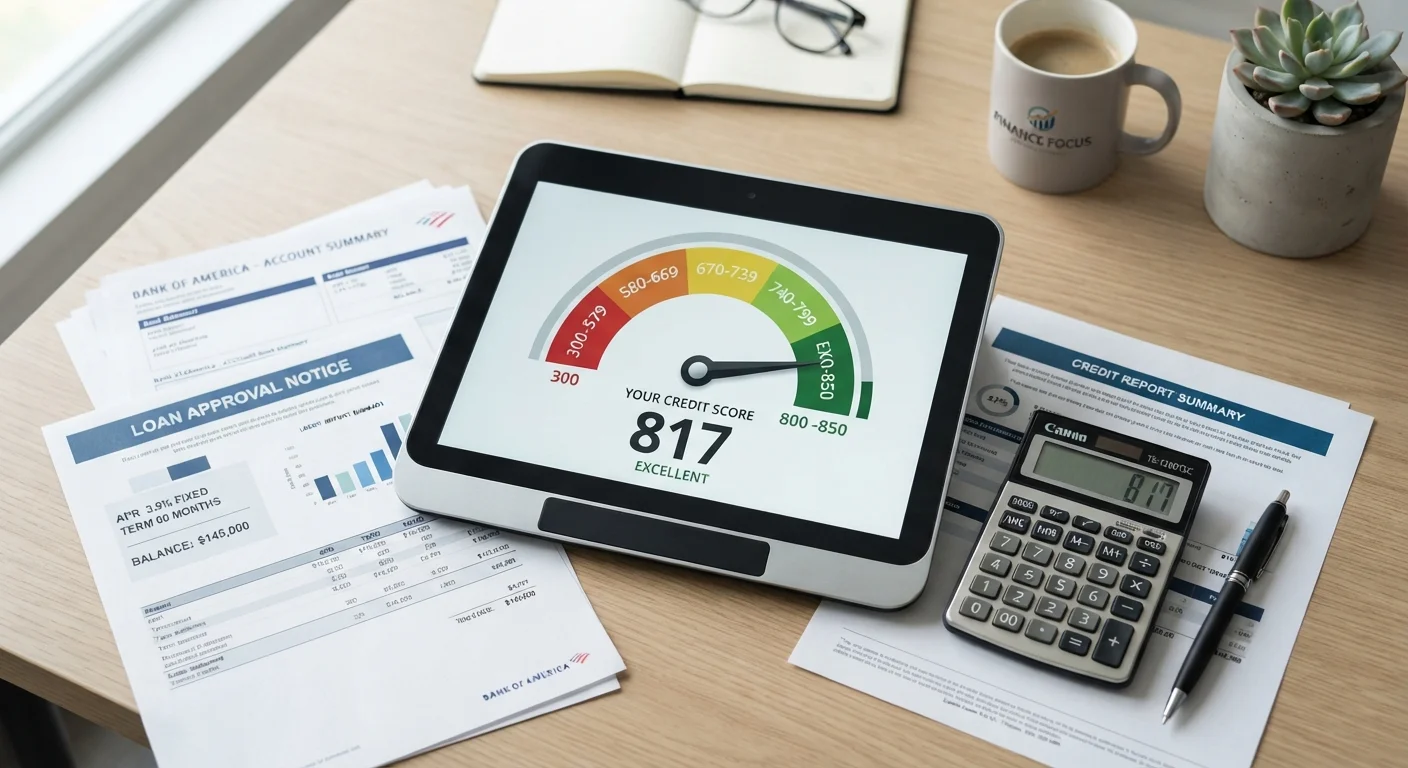
Photo: SummarizedReads.net | Just Read It! editorial
—— In This Article
Key Takeaways
- Your credit score is calculated from five factors, each carrying a different weight.
- Payment history is the single largest factor, accounting for roughly 35% of a FICO score.
- Credit utilization - how much of your available credit you're using - is the second most influential factor.
- A longer credit history generally helps your score, so older accounts have real value.
- Applying for new credit too frequently can cause a small, temporary dip in your score.
- Your income, employment status, and savings balances do not directly affect your credit score.
The Five Factors Behind Your Number
Credit scores can feel like a black box - a number that appears to judge you without explanation. In reality, the calculation follows a clear structure. Under the FICO model, five categories of information from your credit report are each assigned a weight. Understanding those weights puts you in control.
This article is general financial education, not personalized advice. For guidance specific to your situation, consider consulting a licensed financial counselor.
35%
Weight of payment history in FICO score
According to FICO's publicly published score factor breakdown, payment history is the single largest contributor to your score.
30%
Weight of credit utilization in FICO score
FICO's published model assigns the second-largest share of your score to how much of your available revolving credit you are using.
300-850
Standard FICO score range
FICO scores span from 300 (lowest) to 850 (highest), with the majority of U.S. consumers scoring above 600 according to FICO data.
Payment History (35%): The Biggest Weight
More than a third of your FICO score comes from one question: do you pay your bills on time? Every on-time payment adds to a track record that reassures lenders. Every missed or late payment - especially one that's 30 or more days overdue - signals risk and can significantly lower your score.
Bankruptcies, collections, and charge-offs (when a lender writes off a debt as a loss) also live in this category and carry heavy penalties. They don't stay forever - most negative marks fall off your credit report after seven years - but their impact fades gradually over time with consistent positive behavior.
Practical implication: Automating at least the minimum payment on every account is one of the most straightforward ways to protect this portion of your score.
Set Up Autopay for Minimums
You don't have to pay your full balance automatically - just the minimum. Setting up autopay for the minimum due ensures you never accidentally miss a payment and damage your payment history, even in a hectic month. You can always pay more manually on top of that.
Credit Utilization (30%): How Much You're Using
Credit utilization measures the percentage of your available revolving credit - primarily credit cards - that you're currently using. If you have a combined credit limit of $10,000 and carry a $3,000 balance, your utilization is 30%.
Scoring models generally reward lower utilization. Many financial educators suggest keeping it under 30%, though lower is typically better. High utilization signals that you may be financially stretched. Importantly, this factor is recalculated every time your lenders report new balances, so it can improve relatively quickly once balances are paid down.
For a deeper look at how this factor works, see why credit utilization has an outsized effect on your score.
Length of Credit History, Credit Mix, and New Credit
The remaining three factors each carry less individual weight but still matter collectively.
- Length of credit history (15%): Scoring models look at the age of your oldest account, your newest account, and the average age of all accounts. Longer histories give lenders more data to evaluate. This is one reason financial educators often advise against closing old accounts you're not actively using.
- Credit mix (10%): Having experience with different types of credit - revolving accounts like credit cards and installment loans like auto or student loans - shows lenders you can manage various obligations. You don't need to take on debt just to diversify, but a mix generally helps.
- New credit (10%): Each time you apply for credit, a hard inquiry is recorded. Multiple applications in a short window can suggest financial strain. Rate shopping for a single loan (mortgage, auto) within a focused period is usually treated as a single inquiry by most models.
To understand how these factors appear in your underlying credit file, see reading your credit report without getting lost.
What Your Score Doesn't Measure
Just as important as what's included is what's left out. Your credit score does not factor in your income, your savings or investment account balances, your employment status, your age, your race, gender, or marital status. These are legally prohibited from being used in credit decisions under the Equal Credit Opportunity Act.
This surprises many people. A high earner with a pattern of late payments can have a poor score. Someone with a modest income but a long, clean payment history can have an excellent one. The score measures credit behavior, not financial wealth.
Common misunderstandings about this are widespread - things people believe about credit scores that simply aren't true walks through the most common myths with clear corrections.
“A credit score is not a measure of your worth or your wealth - it is a measure of your reliability as a borrower, based strictly on how you've handled credit in the past.”
— Consumer Financial Protection Bureau, U.S. government agency for consumer financial protection
This article is for general informational purposes only and does not constitute personalized financial advice. Consult a qualified financial professional for guidance specific to your circumstances.
Frequently Asked Questions

Finance Editorial Team
Finance Editorial Team is the collective byline for our editorial team and contributor network. Articles published under this byline or an editorial pen name are researched, written, and reviewed according to our editorial standards for clarity, consistency, and independence before publication.
View author profile