
The Honest Pros and Cons of Going Label-Everything Obsessive
Labelling containers and shelves can be transformative — or a time-consuming project that nobody maintains. A balanced look at both sides.
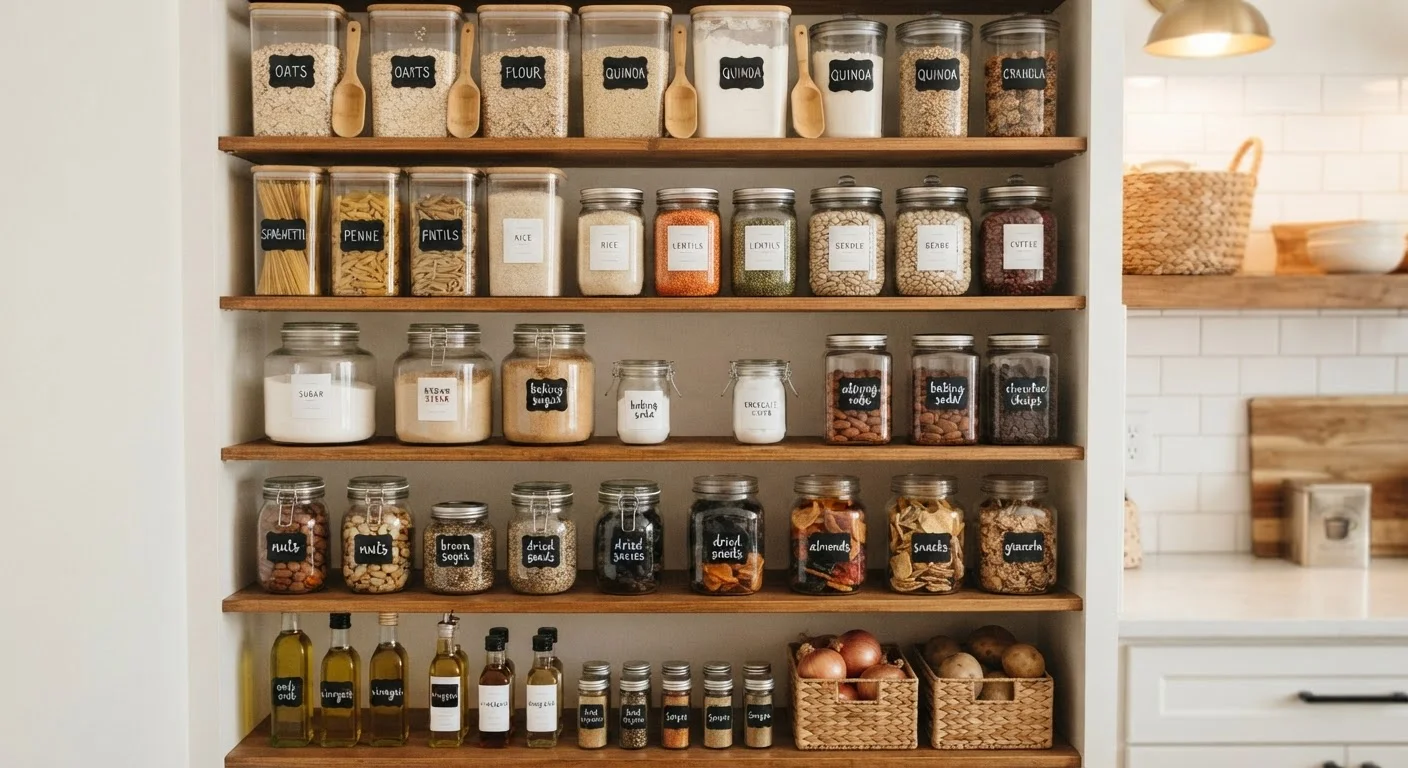
Photo: SummarizedReads.net | Just Read It! editorial
—— In This Article
Key Takeaways
- Labelling systems reduce decision fatigue and help every household member find things independently.
- An overly rigid labelling setup can become burdensome when life or inventory changes frequently.
- The best approach balances consistency in high-traffic zones with flexibility elsewhere.
- Upfront time and cost investments vary widely depending on how elaborate the system becomes.
- Shared households benefit most when everyone agrees on and understands the labelling logic.
Reduces decision fatigue and mental load daily
When every item has a clearly marked home, household members spend less mental energy tracking locations, which adds up to meaningful cognitive relief over time.
Helps multiple household members participate
Visible labels mean partners, children, and guests can find and return items without asking, reducing the organisational burden falling on one person.
Prevents duplicate purchases of forgotten items
Clearly labelled pantry and supply zones make it easier to see what's already on hand, reducing unnecessary spending on items you already own.
Creates a visually calm, easier-to-clean space
Consistent containers and labels reduce visual clutter, which research in environmental psychology links to lower perceived stress in living spaces.
Speeds up restocking and grocery planning
At-a-glance category labels make it immediately clear when a supply is running low, simplifying list-making and reducing last-minute trips.
High upfront time investment to set up correctly
A thorough labelling project - sorting, decanting, measuring, designing, and applying labels - can realistically take an entire weekend, especially in larger homes.
Systems degrade quickly without regular maintenance
Labels that no longer match their contents create confusion and erode trust in the whole system, often faster than people anticipate when initially setting it up.
Can become expensive if over-engineered
Uniform containers, label makers, specialty adhesives, and decorative elements can push costs surprisingly high for what is essentially a storage solution.
Rigid categories struggle with changing household needs
A label suited to today's pantry inventory or a child's current interests may be obsolete within months, requiring rework that many households skip rather than complete.
Only works if everyone in the home follows it
A labelling system built and maintained by one person often fails when other household members don't share the same organisational priorities or simply ignore the labels.
What 'Label Everything' Actually Means in Practice
The label-everything approach goes beyond sticking names on spice jars. At its most committed, it means assigning and marking a designated home for virtually every category of item in the house - pantry staples, cleaning supplies, craft materials, medications, cables, seasonal gear, and more. Labels may be handwritten, printed from a home label maker, or created with a cutting machine for a polished look.
The appeal is obvious: a labelled system communicates intent. It tells anyone who opens a cabinet exactly where things belong, not just where they happen to have landed. For households managing shared spaces or trying to reduce daily mental load, that clarity has genuine value. But the gap between a beautifully labelled pantry and a sustainable, maintained system is worth examining honestly before you invest hours - and potentially real money - into building one.
For a grounded look at how rigid systems compare to more flexible approaches, see our guide to rigid vs. flexible household systems.
The Real Advantages of a Label-Heavy System
Reduces decision fatigue and mental load daily
When every item has a clearly marked home, household members spend less mental energy tracking locations, which adds up to meaningful cognitive relief over time.
Helps multiple household members participate
Visible labels mean partners, children, and guests can find and return items without asking, reducing the organisational burden falling on one person.
Prevents duplicate purchases of forgotten items
Clearly labelled pantry and supply zones make it easier to see what's already on hand, reducing unnecessary spending on items you already own.
Creates a visually calm, easier-to-clean space
Consistent containers and labels reduce visual clutter, which research in environmental psychology links to lower perceived stress in living spaces.
Speeds up restocking and grocery planning
At-a-glance category labels make it immediately clear when a supply is running low, simplifying list-making and reducing last-minute trips.
The strongest argument for labelling is that it externalises memory. Instead of mentally tracking where the batteries live or whether the guest towels are in the hall closet or the linen cupboard, the label does that cognitive work for you. Over time, this compounds: fewer "where is the...?" interruptions, fewer items purchased because the existing stock couldn't be found, and faster restocking because categories are visible at a glance.
Labelled systems also tend to improve participation in shared households. When the logic is visible and consistent, other people - partners, children, roommates - can put things away correctly without needing to ask. This dynamic is explored further in our piece on organising homes with multiple people.
The Honest Drawbacks Worth Considering
High upfront time investment to set up correctly
A thorough labelling project - sorting, decanting, measuring, designing, and applying labels - can realistically take an entire weekend, especially in larger homes.
Systems degrade quickly without regular maintenance
Labels that no longer match their contents create confusion and erode trust in the whole system, often faster than people anticipate when initially setting it up.
Can become expensive if over-engineered
Uniform containers, label makers, specialty adhesives, and decorative elements can push costs surprisingly high for what is essentially a storage solution.
Rigid categories struggle with changing household needs
A label suited to today's pantry inventory or a child's current interests may be obsolete within months, requiring rework that many households skip rather than complete.
Only works if everyone in the home follows it
A labelling system built and maintained by one person often fails when other household members don't share the same organisational priorities or simply ignore the labels.
The single biggest failure mode for label-everything systems is maintenance. Life changes - groceries rotate, kids outgrow toys, hobbies shift - and labels that no longer match their contents quietly undermine the whole system. A bin labelled "PASTA" that now holds rice and lentils is worse than no label at all, because it creates false expectations.
There's also the upfront investment to consider. A comprehensive labelling project can take a full weekend and, depending on materials, cost anywhere from under ten dollars for a basic tape-and-marker setup to well over a hundred for a label maker, uniform containers, and specialty adhesives. That investment only pays off if the system is maintained. The comparison to over-rigid budget categories is apt here - much like the pitfalls outlined in our look at strict budget categories, systems that are too inflexible often get abandoned rather than adapted.
When Labels Work Against You
A label on an empty or misused container isn't neutral - it actively misleads. If you're maintaining a system alone in a household where others don't engage with it, consider whether the effort is producing real results or just visual satisfaction. A simpler, less labelled system that everyone actually uses will almost always outperform an elaborate one that only one person maintains.
Finding the Right Level of Labelling for Your Home
Rather than committing to label everything or nothing, most households do well with a zone-based approach: identify the three to five areas where disorganisation genuinely causes friction, and start there. Pantries, medicine cabinets, kids' activity supplies, and home office drawers are common candidates because their contents are relatively stable and multiple people access them.
Areas with high turnover - a "miscellaneous" drawer, a donation pile, a rotating collection of seasonal items - are generally poor candidates for rigid labels. Flexible solutions like general-category bins or writable-surface containers work better in those spots.
It's also worth revisiting common decluttering myths before investing in a labelling system, since organising clutter rarely eliminates it. Reducing volume first almost always makes any subsequent labelling project faster and more durable.
~$20-$120
Typical cost range for a pantry labelling setup
Estimates vary widely based on whether you use a basic tape-and-marker method or invest in a label maker, uniform canisters, and adhesive solutions.
1 in 3
Households report spending 5+ minutes daily searching for items
Home organisation surveys consistently find that time lost searching for misplaced items is one of the most commonly cited household frustrations.

Home Editorial Team
Home Editorial Team is the collective byline for our editorial team and contributor network. Articles published under this byline or an editorial pen name are researched, written, and reviewed according to our editorial standards for clarity, consistency, and independence before publication.
View author profile