
The Complete Picture on Deals and Coupons: Strategy, Psychology, and Practical Use
A thorough guide covering how the deals ecosystem works, how retailers price strategically, and how shoppers can approach it with clear eyes.
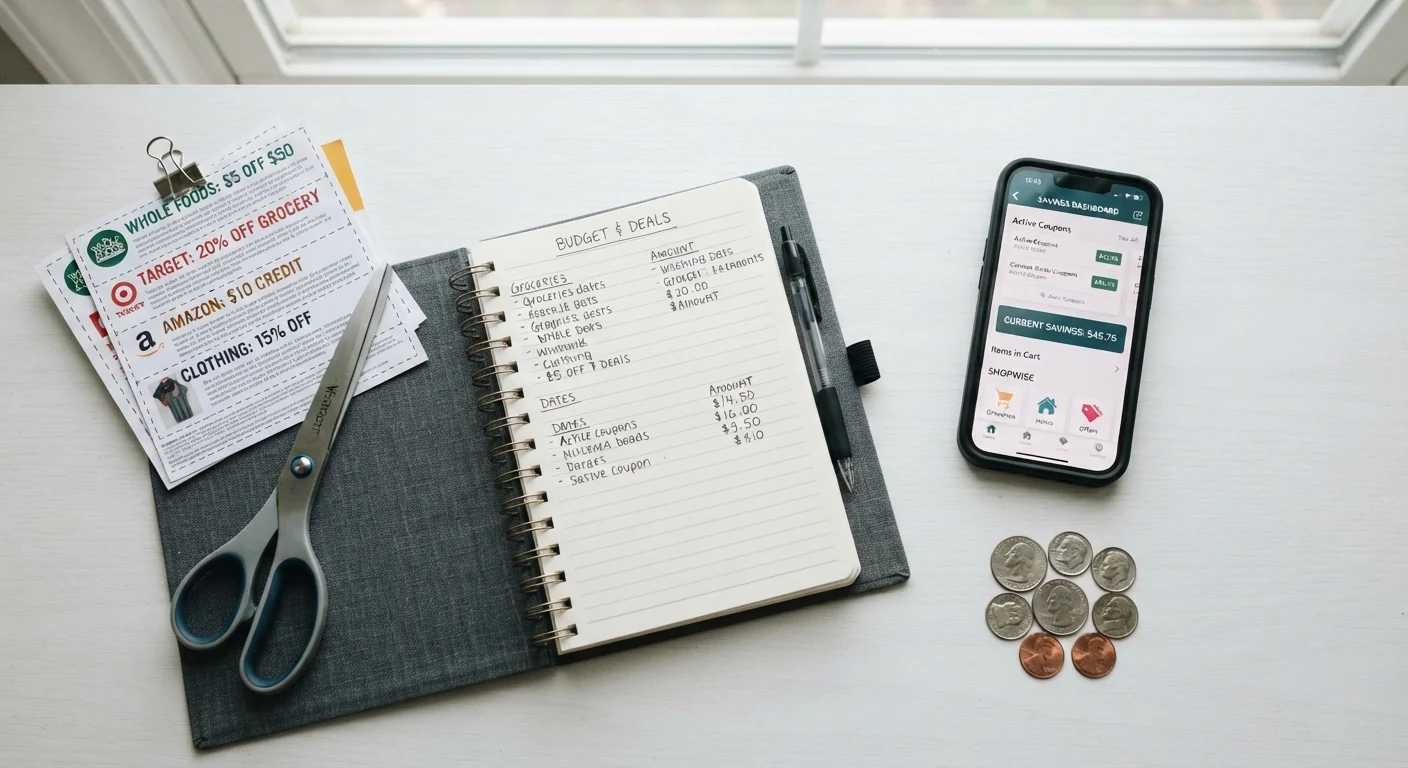
Photo: SummarizedReads.net | Just Read It! editorial
—— In This Article
Key Takeaways
- Retailers price strategically — not every marked-down item reflects a genuine reduction from a stable baseline price.
- Coupons and promotions are designed to influence behavior; understanding that helps you use them on your terms.
- A systematic approach — comparing prices over time, knowing your category's price cycles — outperforms impulse deal-chasing.
- Spending to save is one of the most common ways deals actually cost shoppers money.
- Total cost of ownership, not sticker price, is the most reliable measure of whether a deal is real.
How the Deals Ecosystem Actually Works
The modern deals landscape involves multiple layers: manufacturers, retailers, third-party aggregators, and loyalty programs all play distinct roles. Manufacturers issue coupons to stimulate demand for specific products. Retailers run promotions to drive foot traffic or increase basket size. Aggregator platforms collect and surface deals across merchants, often earning referral revenue in the process.
Understanding these incentives matters. A promotion is rarely purely altruistic — it serves a business goal. That doesn't make deals illegitimate, but it does mean you're always navigating a system designed to influence purchasing decisions. Shoppers who grasp this are better positioned to extract value without being maneuvered into unplanned spending.
For a grounded starting point, the introduction to deal-finding strategies covers the core mechanics without the overwhelm.
~$1,800
Average annual coupon savings per US household
According to data from the Promotion Marketing Association, consistent coupon users can save meaningfully, though individual results vary widely based on shopping habits.
60%+
Shoppers influenced by a sale tag even without price history
Consumer research in behavioral economics consistently shows that sale signage influences perceived value independent of the actual discount magnitude.
4–6 weeks
Minimum price tracking window for reliable baseline
Consumer advocacy researchers generally recommend tracking prices across at least one full promotion cycle before assuming a sale reflects a genuine low.
The Psychology Behind Pricing and Promotions
Retailers rely on well-documented cognitive tendencies to make discounts feel more compelling than they may be. Anchoring — displaying a high original price next to a sale price — influences perceived value even when the anchor was never the item's typical selling price. Scarcity cues like countdown timers or low-stock warnings elevate urgency, sometimes artificially.
Research in behavioral economics consistently shows that the framing of a discount ("Save $20" vs. "20% off") affects how attractive it appears, even when the dollar amount is identical. Shoppers tend to respond more strongly to percentage framing on lower-priced items and dollar-amount framing on higher-priced ones — a pattern retailers deliberately exploit.
“Promotions don't change what things cost — they change how we feel about what we're paying. That's an important distinction for anyone trying to spend rationally.”
— Richard Thaler, Nobel Laureate in Economics, behavioral economics researcher
The practical takeaway: slow down before acting on any time-pressure signal. Genuine savings don't evaporate if you take 24 hours to compare. Our guide on what makes a discount actually worth taking digs deeper into these signals.
Types of Coupons and Discounts Explained
Not all discounts work the same way, and mixing them up can lead to missed savings or misapplied expectations.
- Manufacturer coupons: Issued by the product maker, redeemable at most stores carrying that item. Often stackable with retailer sales.
- Store coupons: Issued by a specific retailer, valid only there. May overlap with manufacturer coupons depending on store policy.
- Digital coupons: Clipped via apps or loyalty accounts, applied automatically at checkout. Convenient but require account enrollment.
- Cashback offers: Rebates paid after purchase, often through third-party apps. The savings are real but delayed — factor in whether the item would have been purchased anyway.
- Price matching: Some retailers will match a competitor's listed price. This isn't a coupon, but it functions similarly and requires no code.
- Loyalty rewards: Points or credits earned per dollar spent. Valuable when redeemed, but can encourage overspending to "earn" rewards faster.
Stack Coupons Strategically, Not Blindly
When a retailer sale overlaps with a manufacturer coupon, that combination can produce a genuinely strong discount — but only if both cover the same item at the same time. Read each coupon's terms before assuming they're combinable. Most retailers publish their coupon stacking policies online or in-store.
Building a Deal-Finding Strategy That Holds Up
Effective deal-hunting is less about chasing every promotion and more about building reliable habits around a few high-value categories. Start by identifying the two or three spending categories where you have predictable, recurring needs — groceries, household supplies, personal care. These are where systematic deal-tracking pays off most consistently.
Track prices over at least four to six weeks before assuming a sale price is genuinely low. Many categories follow predictable promotion cycles tied to seasons, holidays, or inventory turnover. Knowing that pattern lets you plan purchases rather than react to them.
Set a price alert on specific items rather than browsing deal aggregators broadly. Alert-based tracking keeps you focused on planned purchases instead of generating new ones.
Browsing deal sites tends to surface items you weren't intending to buy, which increases total spend even when individual items are discounted.
Before applying a coupon, check whether the underlying price has changed. Retailers sometimes raise the base price before issuing a discount code, leaving the net price unchanged or higher.
This practice, sometimes called "price-washing," is documented by consumer watchdogs and is most common around high-traffic sale events.
For shoppers ready to build lasting habits, deal-hunting habits that hold up over time outlines what experienced budget shoppers actually do — and what they skip.
Common Mistakes That Erase Your Savings
Even disciplined shoppers make errors that quietly offset their gains. The most common:
- Buying more than needed to hit a discount threshold. Spending $75 to qualify for free shipping on a $40 item you needed is not savings — it's $35 of unplanned spending.
- Ignoring total cost of ownership. A discounted appliance with high energy use or expensive replacement parts may cost more over its lifetime than a full-price alternative. The total cost of ownership framework is the right lens here.
- Coupon stacking errors. Combining promotions without reading the fine print can result in a declined code at checkout, or — in rare cases — violations of retailer terms.
- Valuing loyalty points at face value. Redemption rates vary significantly; a point worth 1 cent in one program may be worth 0.5 cents in another.
Chasing Thresholds Can Cost You More
Free shipping minimums, buy-more-save-more tiers, and bonus point thresholds are designed to increase your total spend. Before adding items to your cart to qualify, calculate whether the threshold benefit actually exceeds the cost of the extra items. More often than not, it doesn't.
Putting It All Together
The most effective approach to deals is one that's intentional rather than reactive. Define what you actually need, understand the realistic price range for it, and evaluate promotions against that baseline — not against the anchor price a retailer chose to display.
Coupon strategy works best as a layer on top of sound purchasing decisions, not as the decision itself. If a deal is the only reason you're buying something, that's worth pausing on. But when genuine need and genuine savings align, a well-timed, well-researched discount does exactly what it should.
Explore more practical guidance across the Shopping Tips hub and the Smart Comparisons hub for frameworks that help you evaluate purchases with confidence.

Shopping Editorial Team
Shopping Editorial Team is the collective byline for our editorial team and contributor network. Articles published under this byline or an editorial pen name are researched, written, and reviewed according to our editorial standards for clarity, consistency, and independence before publication.
View author profile