
Bodyweight vs. Free Weights: Choosing the Right Resistance for Where You Are
Both bodyweight and free weight training build strength—but they suit different situations. Understand the trade-offs before deciding what to use.
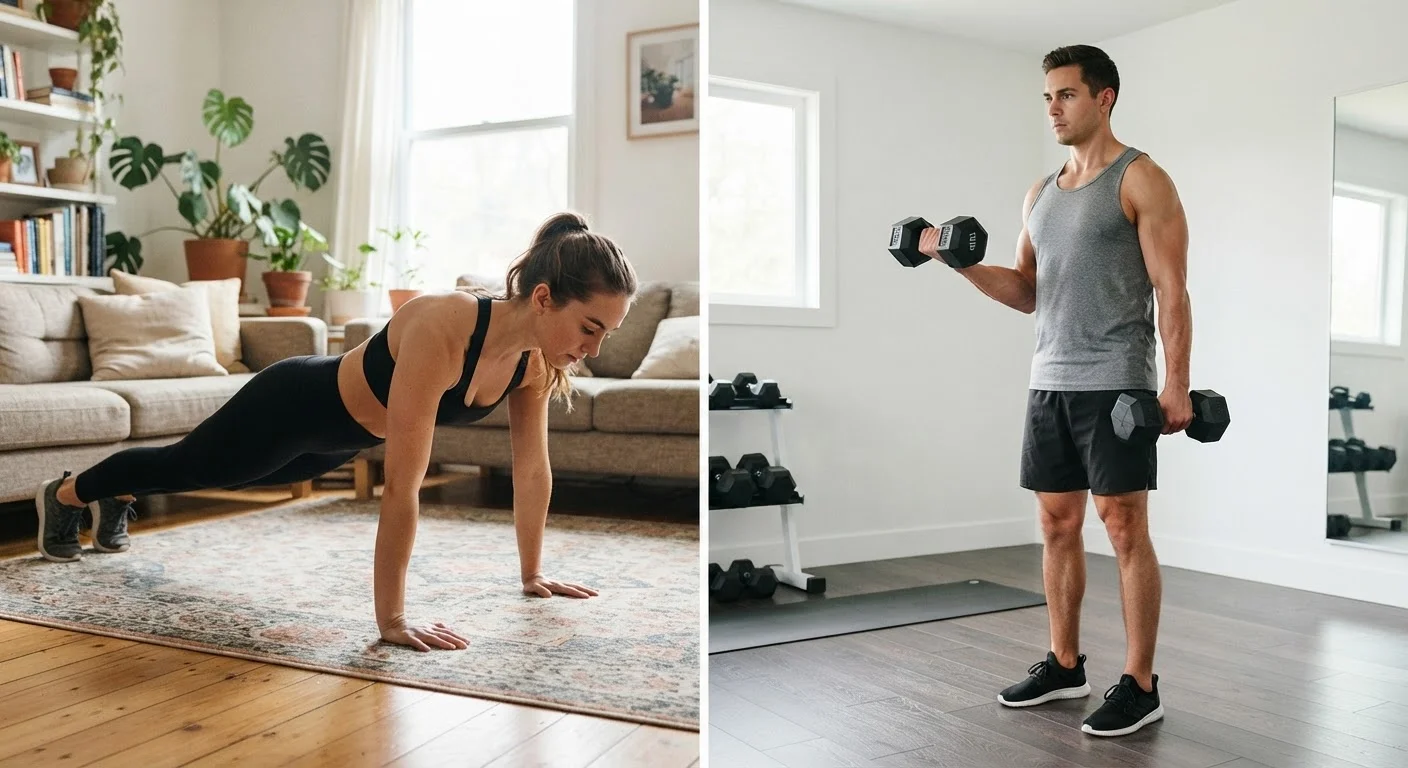
Photo: SummarizedReads.net | Just Read It! editorial
—— In This Article
Key Takeaways
- Bodyweight training requires no equipment and suits beginners, travelers, and tight budgets.
- Free weights allow more precise load progression, which is valuable as strength increases.
- Neither approach is universally superior - context, consistency, and progression matter most.
- Both methods can build meaningful muscle and functional strength when applied correctly.
- Combining the two over time often produces the most adaptable, balanced fitness foundation.
What Each Method Actually Involves
Bodyweight training uses your own mass as resistance - think push-ups, squats, lunges, planks, and dips. No equipment needed, just floor space. Free weights refer to dumbbells, kettlebells, and barbells: tools that add external load you can control and increase over time.
Both approaches trigger the core physiological mechanism behind strength and muscle development: progressive overload - gradually increasing the demand placed on muscles so they adapt and grow. The key difference lies in how that progression happens and how accessible each method is at different life stages.
If you're exploring ways to build a consistent routine without a gym, understanding these two tools is a useful starting point.
Where Bodyweight Training Has the Edge
The most obvious advantage is cost: bodyweight training is free. It also requires minimal space, no commute, and no learning curve around equipment setup. This makes it well-suited to beginners building movement confidence, people in small living spaces, and those staying active on a tight budget.
Bodyweight exercises often develop functional strength - the kind that transfers to everyday movement - because they train multiple muscle groups simultaneously through natural movement patterns. Push-ups build chest, triceps, and core stability at once. A bodyweight squat mirrors how you sit and stand.
Progression is possible within bodyweight training, though it requires creativity: changing leverage (elevating feet for push-ups), reducing support (single-leg squats), or slowing tempo. The ceiling is lower than with free weights, but for many fitness goals - general health, endurance, mobility - it's more than sufficient.
Master the Movement Before Adding Load
Whether you start with bodyweight or free weights, prioritizing good movement form reduces injury risk and builds a stronger foundation. For beginners, spending several weeks on bodyweight fundamentals - squats, hinges, pushes, pulls - before introducing external resistance is a well-supported approach. Quality of movement consistently matters more than the amount of weight used.
Where Free Weights Pull Ahead
The primary advantage of free weights is load specificity. Adding five pounds to a dumbbell is precise and repeatable in a way that changing a push-up variation is not. This matters most when strength and muscle-building are explicit goals, or when someone has already developed a baseline and needs structured overload to keep progressing.
Research in exercise physiology consistently supports resistance training as important for bone density and muscle mass preservation - factors that become increasingly significant with age. For those starting strength training after 40, the ability to modulate load precisely can be especially valuable.
Free weights also allow isolation work - targeting a specific muscle group with deliberate load - which is harder to achieve through bodyweight alone. That said, they come with trade-offs: upfront cost, storage requirements, and a greater need for technique awareness to reduce injury risk.
| Bodyweight Training | Free Weights | |
|---|---|---|
| Upfront cost | Free | Low to moderate (basic dumbbells) |
| Space required | Minimal - floor space only | Moderate - storage needed |
| Beginner accessibility | High - intuitive movements | Moderate - technique learning curve |
| Load progression | Limited - lever/tempo changes | Precise - incremental weight increases |
| Muscle-building ceiling | Moderate | Higher with consistent overload |
| Portability | Complete - no equipment needed | Low - weights don't travel well |
| Injury risk without guidance | Lower for most movements | Higher if technique is poor |
Choosing Based on Where You Actually Are
The honest answer is that both tools work - and that the best choice is the one you'll actually use consistently. A perfect free-weight program abandoned after two weeks delivers less than a modest bodyweight routine done four times a week for months.
Practical questions worth considering: Do you have space and budget for weights? Are you a complete beginner who would benefit from mastering movement patterns first? Do you have a specific goal - like building muscle mass - that genuinely benefits from load progression?
It's also worth noting that these approaches don't have to compete. Many people begin with bodyweight, build foundational strength and movement quality, then incorporate free weights as their fitness develops. That progression is sustainable and doesn't require a gym membership. For comparison with cardio-focused options, see our piece on walking vs. running.
This article is for general informational purposes only and does not constitute medical or fitness advice. Consult a qualified healthcare or fitness professional before beginning any new exercise program, especially if you have existing health conditions or injuries.
2x/week
Minimum resistance training frequency for benefit
Major health guidelines, including those from the U.S. Department of Health and Human Services, recommend muscle-strengthening activity at least twice weekly for adults.
~1%
Annual muscle mass loss without training after 30
Exercise physiology research suggests adults can lose roughly 1% of muscle mass per year from their 30s onward without adequate resistance training stimulus.

Health Editorial Team
Health Editorial Team is the collective byline for our editorial team and contributor network. Articles published under this byline or an editorial pen name are researched, written, and reviewed according to our editorial standards for clarity, consistency, and independence before publication.
View author profile