
The Truth About 'Limited Time' Deals and Urgency Tactics in Retail
Countdown timers and 'only 3 left' notices are common retail tools. Learn what's real, what's manufactured, and how to stay level-headed.
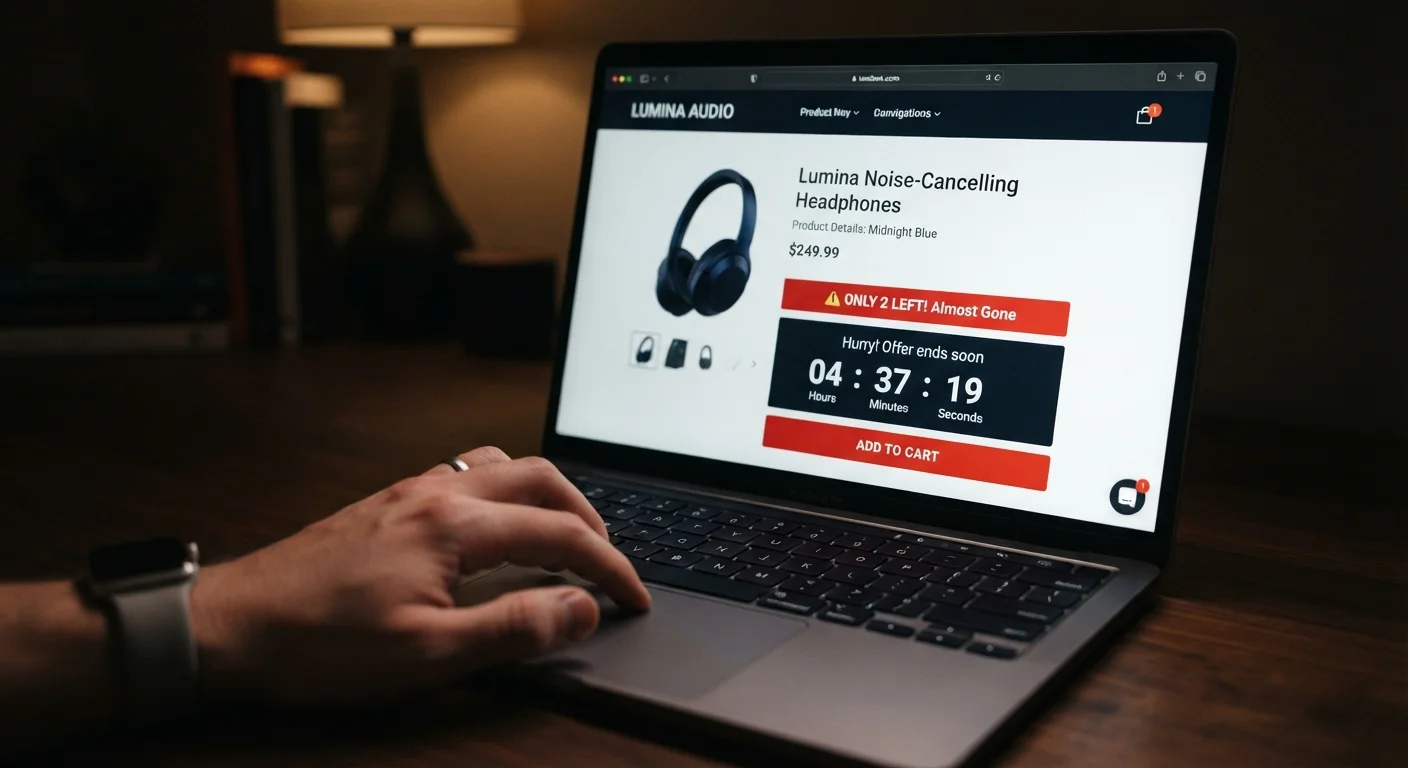
Photo: SummarizedReads.net | Just Read It! editorial
—— In This Article
Key Takeaways
- Countdown timers and low-stock alerts are marketing tools, not always accurate inventory signals.
- Many 'limited time' prices recur regularly or are set against inflated reference prices.
- Scarcity messaging activates psychological pressure that can override rational decision-making.
- Price-tracking tools let you verify whether a discount is genuinely new or a recurring baseline.
- Pausing before purchasing is one of the most effective defenses against manufactured urgency.
How Urgency Tactics Work — and Why They're So Effective
Walk through almost any retail website and you'll encounter them within seconds: ticking countdown clocks, banners reading "Sale ends tonight," notifications that only a handful of items remain. These are deliberate design choices, not incidental features. Retailers deploy urgency cues because behavioral research consistently shows that perceived scarcity and time pressure shorten the gap between browsing and buying.
The mechanism is well-documented in consumer psychology literature. When shoppers believe they might miss out, the brain's threat-response pathways can override slower, more deliberate evaluation. The result is that a purchase that wouldn't survive five minutes of calm reflection can feel urgent and justified in the moment. Understanding that the feeling itself is the product being sold is the first step toward shopping on your own terms.
For a deeper look at the cognitive triggers involved, see how retailers exploit impulse-buying psychology.
Myth
If a countdown timer says the deal expires in two hours, the price will definitely go up when it hits zero.
Fact
Many countdown timers reset automatically or the same price persists indefinitely after the "deadline" passes.
Countdown timers are a standard e-commerce feature that can be configured to reset on each page visit, each browser session, or on a fixed schedule that repeats weekly. Consumer advocacy testing by organizations such as Which? in the UK and similar watchdog groups in the U.S. has documented cases where prices remained unchanged long after a displayed timer expired. The timer communicates urgency; it does not necessarily communicate accurate scheduling information.
Myth
"Only 3 left in stock" means the item is genuinely almost sold out.
Fact
Low-stock alerts are often triggered by software thresholds, not real-time warehouse counts, and the same message may persist for days or weeks.
Many retail platforms allow merchants to set a threshold — say, any quantity below 10 — that automatically triggers a low-stock warning regardless of actual scarcity. The item may have dozens of units available at a regional warehouse, or the figure may reflect a single retail location's count rather than the full supply chain. Treat these notices as a marketing prompt rather than reliable inventory data, particularly on large marketplace platforms where individual seller controls vary widely.
Myth
A sale price shown alongside a crossed-out "original" price always reflects what the item actually cost before.
Fact
Reference prices are sometimes set artificially high and may not reflect a price at which the product was meaningfully sold.
The FTC's Guides Against Deceptive Pricing state that a "former price" comparison is deceptive if the item was not actually offered at that price for a reasonable period and in good faith. Despite this guidance, inflated reference prices remain a documented practice. Independent price-tracking data frequently shows that a product's "sale" price is actually its standard price most of the year, with a briefly elevated reference price used to manufacture a discount figure. Checking a product's historical price on a tracking tool gives you the real comparison point.
Myth
Flash sales offer prices you genuinely cannot find at other times of year.
Fact
Many flash sale prices match or are only marginally below prices available during major seasonal sales events or through standard coupon stacking.
Flash sales are partly a logistics tool — retailers use them to move aging inventory — and partly an attention mechanism designed to create return visits. The prices may be real markdowns, but the "exclusive" framing is often overstated. Major product categories follow fairly predictable seasonal pricing patterns. A flash sale price on a television in September, for example, may be matched or beaten by Black Friday pricing two months later. Building a rough understanding of category-level pricing cycles is more useful than treating any single flash event as a unique opportunity.
Myth
Acting quickly on a deal prevents regret — if you wait, you'll miss out and pay more later.
Fact
For most non-perishable consumer goods, comparable prices recur regularly; the cost of waiting is usually lower than the cost of an impulsive purchase.
The fear of missing out is a well-studied psychological phenomenon that retailers deliberately activate. In practice, most consumer electronics, apparel, home goods, and similar categories cycle through comparable discount depths multiple times per year. Missing one sale event rarely means permanently paying a higher price. By contrast, an impulsive purchase driven by urgency — particularly one of an item not on a shopping list — carries real financial cost and often leads to returns or regret. A disciplined waiting strategy, even a short one, materially improves purchase satisfaction across repeated purchasing decisions.
What the Research and Regulatory Record Actually Show
Urgency tactics exist on a spectrum. Some reflect genuine constraints — a venue with fixed seating, a flash sale tied to a supplier agreement, or authentic end-of-season clearance. Others are mechanically generated: countdown timers that reset on page reload, stock counters that don't reflect real inventory, or "original" prices set artificially high to make a discount look steeper than it is.
~76%
Shoppers influenced by scarcity messaging
Research published in the Journal of Marketing Research has found that low-stock cues can significantly increase purchase likelihood, with some studies reporting influence rates above 70% among exposed shoppers.
1 in 3
"Sale" prices at or below supposed original price
Analysis by consumer groups examining major retail events has found that a substantial share of promoted discounts were available at the same or lower prices in the weeks preceding the sale.
Regulators in the U.S. have taken notice. The Federal Trade Commission has published guidance on deceptive pricing, and several state attorneys general have pursued cases involving fictitious reference prices and misleading urgency claims. That doesn't mean every timer is fraudulent — it means shoppers are justified in treating these signals skeptically rather than as reliable information.
Knowing when prices genuinely tend to fall is more useful than reacting to manufactured deadlines. A seasonal sales calendar gives you a factual baseline to compare against any "today only" claim.
Don't Rely on Site-Displayed Prices Alone
The price shown on a retail page — including any crossed-out "was" price — reflects what the seller has chosen to display, not an independently verified market value. Before acting on a significant discount, spend two to three minutes checking the same product on at least one independent price-history tool. This single step removes most of the information asymmetry that urgency tactics rely on.
If a deal appears implausibly steep or the site itself raises doubts, cross-reference with red flags that signal a potential scam before entering payment details.
Practical Ways to Stay Level-Headed
Skepticism doesn't mean avoiding all sales — it means evaluating them on verifiable evidence rather than emotional pressure. A few habits make a measurable difference:
- Track prices before acting. Browser extensions and dedicated price-history tools log a product's price over time. A "40% off" claim that sits against a price the item has held for six months is a very different proposition from a genuine markdown.
- Apply a waiting period. Adding an item to a wishlist or cart and returning in 24–48 hours filters out manufactured urgency. If the deal has genuinely expired, you've lost a discount that may recur anyway. If it hasn't, the timer was theater.
- Read the fine print on "original" prices. The FTC's guidelines on comparative pricing specify that a reference price should reflect a price at which the item was actually sold in meaningful quantities. When in doubt, search the product at other retailers to see what it commonly costs.
For a broader framework on evaluating whether a discount is structurally sound, the anatomy of a good deal covers the signals that separate genuine value from marketing illusion. And if you want to build habits that hold up across all types of shopping, deal-hunting habits that hold up over time is a practical starting point. It's also worth knowing which discount structures quietly work against shoppers before committing to a purchase.
The Deal Is Not the Goal — Value Is
A purchase that saves 30% on something you didn't need still costs 70% more than not buying it at all. Before responding to any urgency cue, ask whether the item was already on your shopping list and whether the price is verifiably lower than its typical level. If both answers are not clearly yes, the "deal" may be costing you rather than saving you money. This is general information to help you think through purchasing decisions, not financial advice.

Shopping Editorial Team
Shopping Editorial Team is the collective byline for our editorial team and contributor network. Articles published under this byline or an editorial pen name are researched, written, and reviewed according to our editorial standards for clarity, consistency, and independence before publication.
View author profile