
Doing Your Own Side-by-Side Comparison When No Review Site Covers Your Exact Use Case
Review sites rarely match your precise situation. A practical method for constructing your own structured comparison using publicly available information.
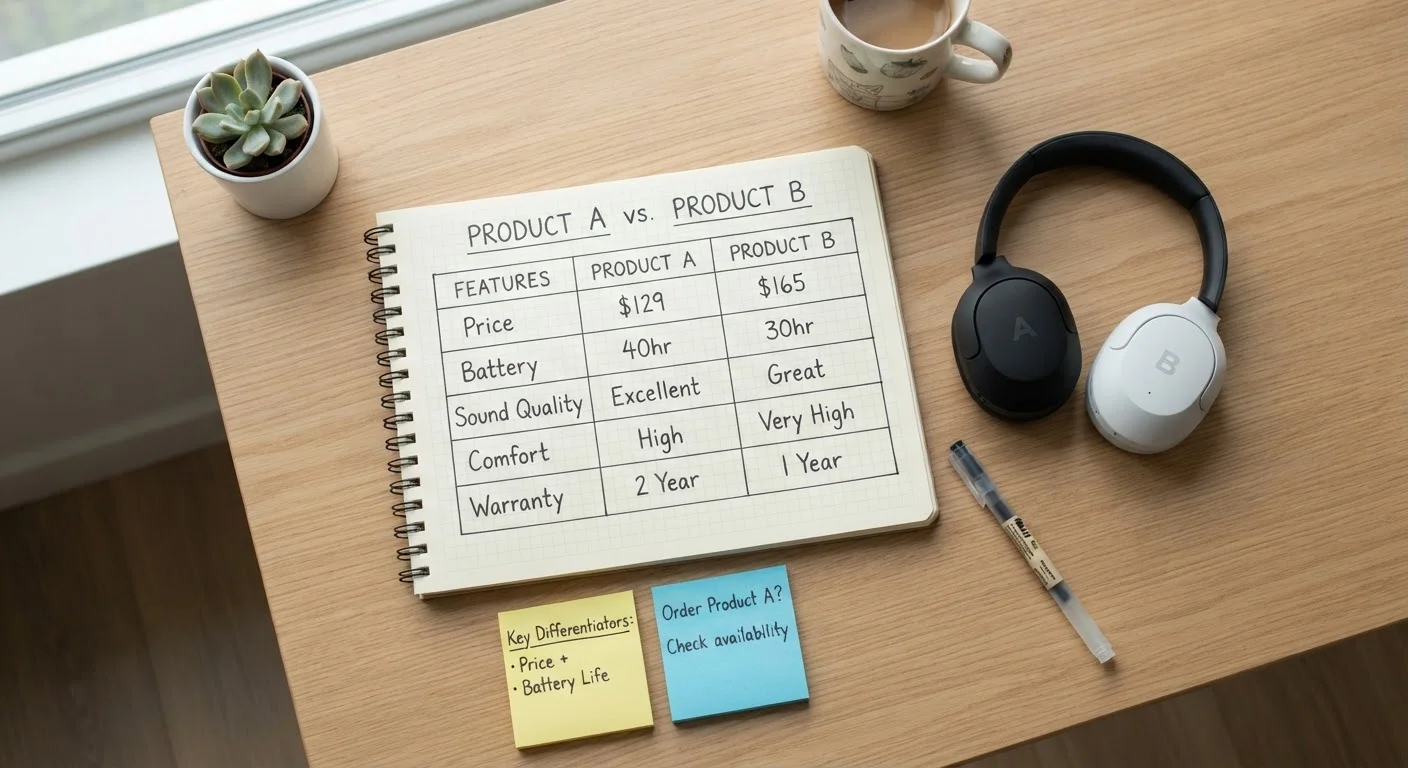
Photo: SummarizedReads.net | Just Read It! editorial
—— In This Article
Key Takeaways
- Published review sites optimize for broad audiences, not your specific constraints or priorities.
- A personal comparison framework starts with clearly defined criteria before any product research begins.
- Weighting your criteria by importance converts a list of specs into a decision-ready score.
- Primary sources — manufacturer specs, user forums, return policy pages — are more reliable than aggregated summaries.
- Hidden variables like running costs, compatibility, and warranty terms often change the outcome entirely.
Why Generic Review Sites Fall Short for Specific Use Cases
Most review sites are written for the median buyer. Their comparison tables optimize for the attributes that matter to the largest share of readers — which may have little overlap with your actual situation. A home cook in a small apartment comparing cooktops faces different constraints than the person a review site imagined when it wrote its cooktop comparison. The specs reviewed may not include your voltage situation, your ventilation constraints, or whether you rent.
The solution isn't to find a better review site. It's to build your own structured comparison using the same raw inputs — spec sheets, community forums, policy documents — that a good reviewer would consult, filtered through your specific criteria rather than a generalized rubric.
Before you build anything, though, be aware that cognitive biases like anchoring and decoy pricing can distort your evaluation if you aren't deliberate about the order in which you gather information. Setting your framework first is a structural defense against those effects.
What you will need
How to Build and Use Your Comparison Grid
The method below is designed to be completed in a single focused session for most purchases, or across a few hours for complex ones. You'll need the tools listed below, and the process works for physical products, appliances, and many services — though if your comparison involves a service contract or subscription, some additional criteria apply.
Spreadsheet (any platform)
Build and maintain your weighted scoring grid with options as columns and criteria as rows.
Manufacturer spec pages
Pull verified technical details directly from the source for each option under consideration.
User forums and community Q&A sites
Surface real-world edge cases and long-term reliability patterns not captured in launch reviews.
Retailer return and warranty policy pages
Confirm post-purchase protections, which often differ significantly between otherwise similar options.
Web archive or cached pages
Retrieve older versions of product pages to check for specification changes or price history.
Define your criteria before touching any product page
Write down every requirement your purchase must satisfy. Split them into two columns: hard constraints (non-negotiable — a dimension limit, a compatibility requirement, a firm budget ceiling) and preferences (important but flexible). If you haven't done this structured needs audit yet, the baseline-setting guide walks through the process in detail.
Assign a weight to each criterion
Not all preferences carry equal weight. Assign each preference criterion a number from 1 (nice to have) to 3 (strongly matters). This step forces you to make trade-off decisions before you are emotionally invested in any specific option — which is exactly when you are best positioned to think clearly.
Select your options using hard constraints only
Use your hard-constraint list as a filter, not a ranking tool. Any option that fails a single hard constraint is removed from your grid entirely. Do not let strong performance on preferences offset a hard-constraint failure — that is how buyers end up with a product that technically doesn't fit their situation.
Gather data from primary and independent sources
For each surviving option, collect data on every preference criterion. Prioritize primary sources (manufacturer spec sheets, official documentation) for technical claims, and independent sources (user communities, verified purchaser reviews, third-party tests) for real-world performance. Be aware that hidden variables like running costs and warranty terms are rarely on the headline comparison chart but often change the final outcome.
Score each option on each criterion and calculate totals
Enter a score from 1 to 5 for each option on each criterion, based solely on the data you gathered. Multiply each score by the criterion's weight. Sum the weighted scores across all criteria for each option. The resulting totals give you a structured, revisable ranking — not a definitive verdict, but a transparent record of your reasoning.
Pressure-test your top result before committing
Before finalizing, ask: Does the top scorer pass every hard constraint without exception? Are there hidden costs — consumables, installation, subscription fees — that weren't in your original grid? Check the retailer's return policy in case reality doesn't match the spec sheet. If your comparison involves a service rather than a physical product, note that the methodology differs meaningfully and may require additional criteria around reliability and support terms.
Use a Simple Weighted Scoring Table
Assign each criterion a weight from 1 to 3 based on importance to you. Score each option on that criterion from 1 to 5. Multiply weight by score for each cell, then sum the rows. This converts subjective impressions into a defensible, revisable number you can share with a household decision-maker or revisit later.
Define Criteria Before You Research Products
Looking at products before you set your criteria is one of the most common comparison mistakes. Exposure to one option first will anchor your thinking and bias every subsequent evaluation. Write down what matters to you — and in what order — before opening a single product page.
Spec Sheets Can Be Selectively Accurate
Manufacturers are not obligated to disclose unflattering details on their own product pages. Cross-reference spec claims against independent technical documentation, user forum threads, and verified purchaser reviews. A figure that appears only on a manufacturer's site should be treated as unconfirmed until corroborated.
Once your grid is complete and your top option is pressure-tested, you'll have a documented rationale you can revisit if circumstances change — a budget shifts, a new model releases, or a return becomes necessary. That paper trail is something no review site can give you for your specific situation. For a broader look at what typically goes unexamined in off-the-shelf comparisons, see the hidden variables that break most product comparisons.

Shopping Editorial Team
Shopping Editorial Team is the collective byline for our editorial team and contributor network. Articles published under this byline or an editorial pen name are researched, written, and reviewed according to our editorial standards for clarity, consistency, and independence before publication.
View author profile