
Store Brand vs. Name Brand: What the Research Actually Shows
Decades of consumer research have tested generic vs. branded goods. Here's what the evidence says about quality, ingredients, and when it matters.
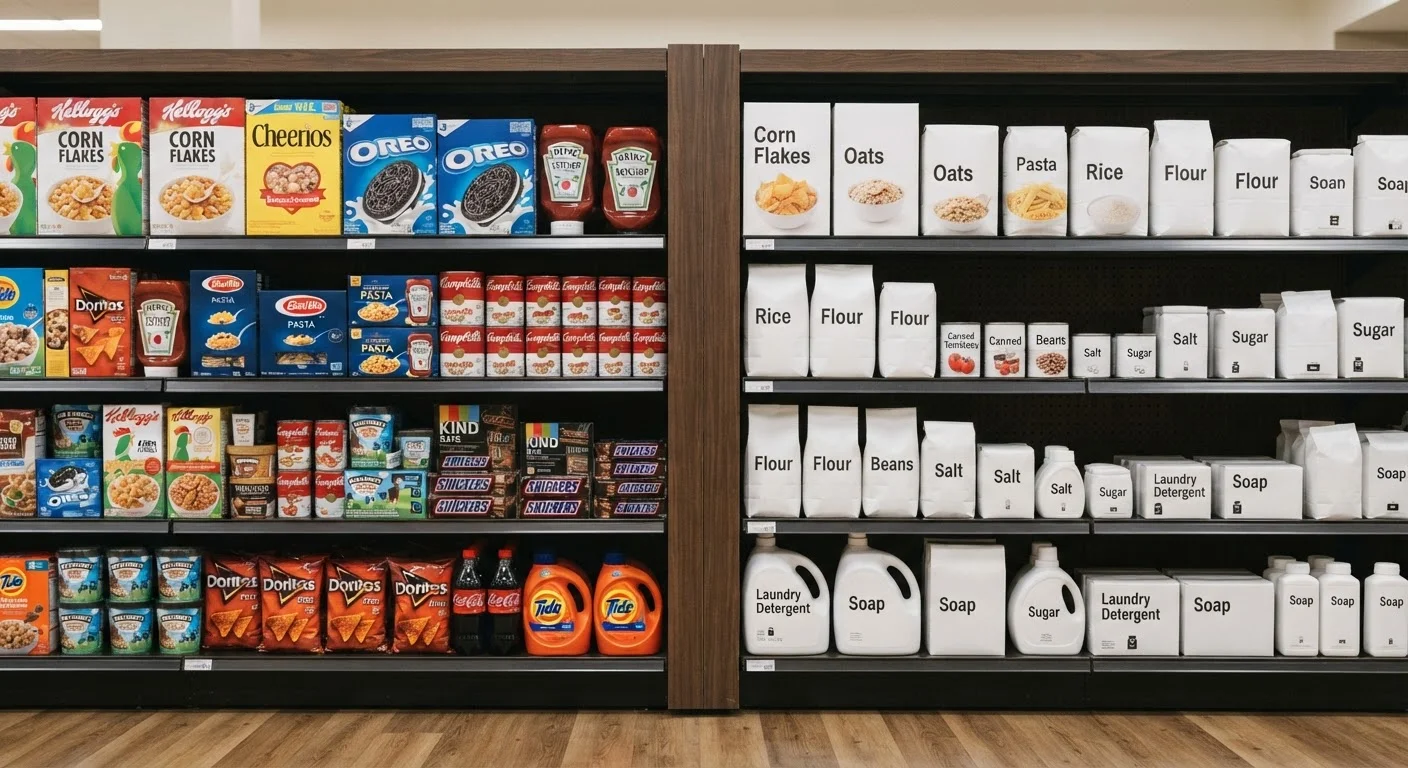
Photo: SummarizedReads.net | Just Read It! editorial
—— In This Article
Key Takeaways
- Store brands and name brands often share manufacturing sources and near-identical ingredient lists in many categories.
- Consumer taste tests show mixed results — perceived quality differences frequently reflect brand expectations, not actual formula gaps.
- Price gaps between store and name brands typically range from 20% to 40%, according to retailer and academic analyses.
- Category matters most: pharmaceuticals, basic pantry staples, and cleaning products are strong areas for store brands.
- Name brands hold a meaningful edge in categories where proprietary formulations or technology genuinely differ.
- Reading ingredient labels and comparing active substances is the most reliable method for evaluating parity.
What Decades of Research Actually Found
The store-brand-versus-name-brand debate has attracted serious academic attention since at least the 1970s. Researchers at institutions including the Wharton School and Erasmus University have repeatedly found that quality gaps — where they exist — are narrower than price gaps suggest. A widely cited meta-analysis of blind taste tests found that store brands were rated statistically equivalent to name brands in the majority of food categories studied.
The clearest finding across studies is that consumer perception is heavily shaped by packaging and brand familiarity. When labels are removed, preference margins shrink considerably. One mechanism at play is the "halo effect" — a cognitive bias where brand recognition inflates quality expectations before a product is even tasted or used. For a deeper look at how pricing contexts distort evaluation, see how anchoring and decoy pricing affect product comparisons.
20–40%
Typical store-brand price discount vs. name brand
Retailer and academic analyses consistently place the price gap in this range across grocery and household product categories.
~72%
Food categories where store brands rated equivalent in blind tests
A meta-analysis of consumer blind taste tests found store brands rated statistically equivalent to name brands in roughly 7 out of 10 food product categories studied.
Same active ingredient
FDA standard for OTC generic drug equivalence
U.S. FDA regulations require generic over-the-counter drugs to contain identical active ingredients at identical dosages to their branded equivalents.
The strongest evidence for store-brand parity comes from the pharmaceutical category. The U.S. Food and Drug Administration (FDA) mandates that generic OTC drugs contain identical active ingredients at identical dosages to their branded counterparts — this is regulatory equivalence, not marketing language.
Where the Gap Is Real vs. Where It Isn't
Research does identify categories where name brands maintain a measurable advantage. These tend to be product lines involving proprietary formulations, patented delivery mechanisms, or complex manufacturing tolerances — think certain electronics components, specialized skincare actives, or fermented food products where cultures and processing affect the final result significantly.
In contrast, the case for store brands is strongest in commodity-like categories:
- Basic pantry goods (flour, sugar, canned vegetables, olive oil): ingredient lists are frequently identical; differences are cosmetic.
- OTC pharmaceuticals: FDA bioequivalence standards apply to prescription generics; active-ingredient parity rules govern OTC equivalents.
- Cleaning and laundry products: independent lab testing has repeatedly found comparable active-ingredient concentrations.
- Paper goods and storage products: performance is largely a function of material weight and construction, which can be assessed directly.
The less reliable category for store brands includes items where the manufacturing process itself is the product — artisan foods, probiotic supplements with specific strain counts, or technology accessories with proprietary safety certifications.
| Criterion | Store Brand | Name Brand |
|---|---|---|
| Average price difference | 20–40% lower (typical) | Baseline price point |
| OTC drug active ingredients | FDA-mandated equivalence | Same active ingredients |
| Basic food ingredient parity | Often identical | May include proprietary additives |
| Proprietary formulations | Rarely replicated | Unique to brand |
| Marketing spend baked into price | Minimal | Significant |
| Blind taste-test performance (food) | Comparable in most categories | Marginal advantage in some |
| Availability | Retailer-specific | Multi-channel, widely available |
For a category-by-category breakdown of where parity holds and where it breaks down, generic vs. name-brand products examined in detail provides additional context.
How to Evaluate Any Pair of Products Yourself
The most reliable consumer strategy is label-level comparison rather than brand-level assumption. Here is a practical framework:
- Compare active or functional ingredients first. For OTC drugs, match active ingredients and percentages. For food, compare nutrition facts panels and ingredient order (ingredients are listed by weight, descending).
- Check for meaningful formulation differences. A store-brand lotion may contain the same active moisturizing agents as a name brand but in different concentrations or with different secondary ingredients that affect texture or absorption.
- Factor in per-unit cost. Price-per-ounce or price-per-dose figures give a more honest comparison than sticker price. Sale pricing myths that mislead shoppers explains why headline discounts on name brands can still leave store brands cheaper after the markdown.
- Consider your purchase channel. Store brands are generally only available in-store or on that retailer's own website. Shopping online vs. in-store can help determine where each option costs less overall.
When Hidden Variables Change the Comparison
Beyond ingredients, factors like packaging size, shelf life, return policies, and retailer-specific quality tiers can affect the true value of either option. Store-brand quality also varies by retailer — a premium private-label line at one chain may outperform a budget national brand, while a basic store brand elsewhere may not. Hidden variables that break most product comparisons covers additional factors worth checking before you decide.
No framework replaces your own experience. Buying a single unit of a store-brand product to test before committing to a large quantity is a straightforward approach that research consistently supports as more effective than relying on brand reputation alone.

Shopping Editorial Team
Shopping Editorial Team is the collective byline for our editorial team and contributor network. Articles published under this byline or an editorial pen name are researched, written, and reviewed according to our editorial standards for clarity, consistency, and independence before publication.
View author profile