
Unit Price vs. Sticker Price: The Number Retailers Don't Want You to Notice
Sticker prices hide the real cost. Learn how unit pricing works and why it's the most reliable measure for comparing everyday products.
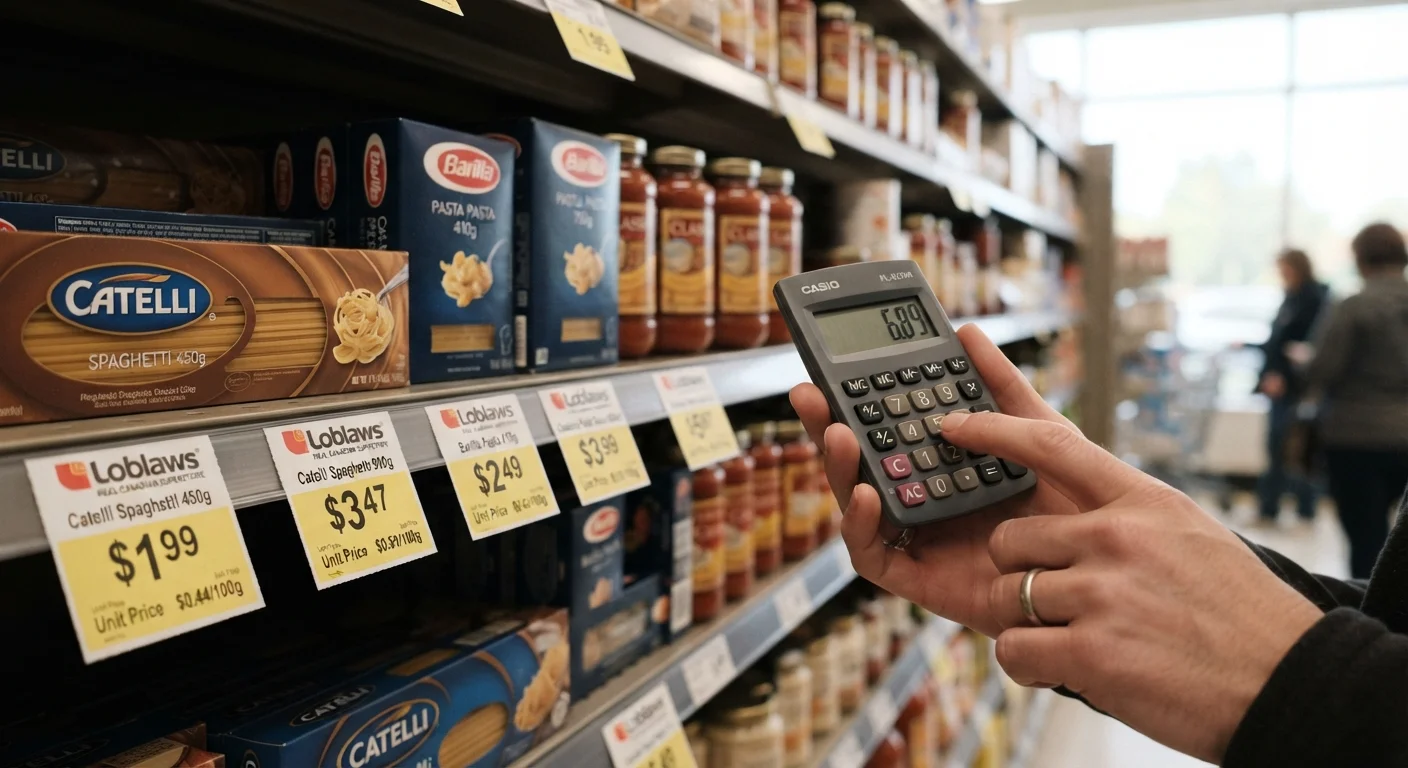
Photo: SummarizedReads.net | Just Read It! editorial
—— In This Article
Key Takeaways
- Unit price — not sticker price — is the only reliable way to compare products of different sizes.
- Larger packages do not always have a lower unit price; smaller sizes sometimes offer equal or better value.
- Many retailers display unit price on shelf labels, but the font is often much smaller than the sticker price.
- Sale stickers can obscure unit price comparisons by drawing attention to percentage-off figures instead.
- Calculating unit price takes seconds with a phone calculator and can prevent overpaying repeatedly over time.
Why Sticker Price Is the Wrong Number to Compare
When you grab two products off a shelf, your eye goes to the price tag. That's by design. Retailers spend considerable effort making the sticker price the dominant visual — large font, bold color, prominent placement. But sticker price alone tells you almost nothing useful about value when packages differ in size, count, or volume.
A $3.49 bottle of dish soap and a $5.99 bottle look like an obvious choice in favor of the cheaper one — until you check that the first is 16 oz and the second is 30 oz. The apparent savings disappear. In fact, the pricier bottle costs less per ounce. This is exactly the kind of comparison retailers don't structurally discourage, because inconsistent sizing makes direct comparison harder and nudges shoppers toward choices that may not reflect their actual interests.
For a broader look at how comparison contexts are designed to influence decisions, see our piece on anchoring and decoy pricing.
~30%
Shoppers who regularly check unit price
Consumer research consistently finds that fewer than one-third of shoppers actively consult the unit price when making purchase decisions, despite its availability on most shelf labels.
Up to 40%
Potential per-unit cost difference between sizes
Studies of grocery pricing have found per-unit cost disparities of up to 40% between different package sizes of the same product, with the smaller size sometimes being the better value.
How Unit Price Actually Works
Unit price standardizes comparisons by expressing cost per consistent measure — per ounce, per count, per sheet, per load. To calculate it, divide the total price by the total quantity listed on the package.
- Cereal: $4.29 for 18 oz = $0.238/oz vs. $5.49 for 24 oz = $0.229/oz. The larger box wins narrowly.
- Paper towels: A 6-pack at $7.99 with 120 sheets per roll = $0.011/sheet. An 8-pack at $9.99 with 100 sheets per roll = $0.012/sheet. The smaller pack wins on unit price despite the lower total count.
- Bottled water: A 24-pack of 16.9 oz bottles at $4.99 = $0.012/oz. A 12-pack of the same size at $3.49 = $0.017/oz. Buying more is cheaper per ounce here.
These examples illustrate that neither size nor price is a reliable proxy for value on its own. Only the unit price calculation settles the question.
Use Your Phone Calculator at the Shelf
Divide the total price by the total ounces, count, or other unit listed on the package. This single calculation takes under 10 seconds and removes all ambiguity from a size comparison. Many grocery apps and store loyalty apps also display unit price automatically when you scan a barcode.
When Sales Make Unit Price Harder to See
Promotional pricing adds a layer of complexity. A "20% off" sticker on a smaller size can temporarily make it a lower unit price than an unmarked larger package — a legitimate deal. But the same sale framing can also be used on a package that was already the worse unit-price option, making the discount feel significant when the math still favors another product.
This is compounded by the fact that sale tags often obscure or replace the standard shelf label where unit price would normally appear. When a bright promotional tag is in place, take a moment to verify the unit price independently rather than trusting that the discounted item is the value choice. Our article on sale pricing myths explores how percentage-off framing can mislead even careful shoppers.
It's also worth noting that some discount structures — bulk minimums, multi-buy requirements — can push you toward buying more than you need to get a lower unit price. That's only a genuine saving if you'll actually use the product. See discount traps that cost more than they save for a practical breakdown.
State Laws on Unit Price Disclosure Vary
Many U.S. states require retailers above a certain size to display unit pricing on shelf labels, but the specific requirements — which products are covered, how the information must be formatted — differ by state. If you don't see a unit price on a label, you are always entitled to calculate it yourself from the package information. Online grocery platforms are increasingly required to display unit prices as well, though compliance is uneven.
Making Unit Price a Consistent Habit
The practical barrier to using unit price is small: it takes a few seconds with a phone calculator. Most large retailers also display it on shelf labels — look for the smaller number, often expressed as "price per oz" or "price per ct," in the lower portion of the label. If you shop the same products regularly, noting the unit prices of your preferred items gives you a baseline to recognize when a deal is genuine.
Unit pricing is most impactful for products you buy frequently in varying sizes — cleaning supplies, pantry staples, personal care items, and paper goods. For less frequent or one-off purchases, the calculation is equally valid but the compounding benefit is lower.
The Shopping Tips hub covers additional strategies for making consistent, evidence-based comparisons rather than relying on how a deal is framed at the shelf.
Frequently Asked Questions

Shopping Editorial Team
Shopping Editorial Team is the collective byline for our editorial team and contributor network. Articles published under this byline or an editorial pen name are researched, written, and reviewed according to our editorial standards for clarity, consistency, and independence before publication.
View author profile