
Morning Routine vs. Evening Routine: What Changes and Why
Your skin has different needs during the day than at night. Understand why AM and PM routines call for different products and priorities.
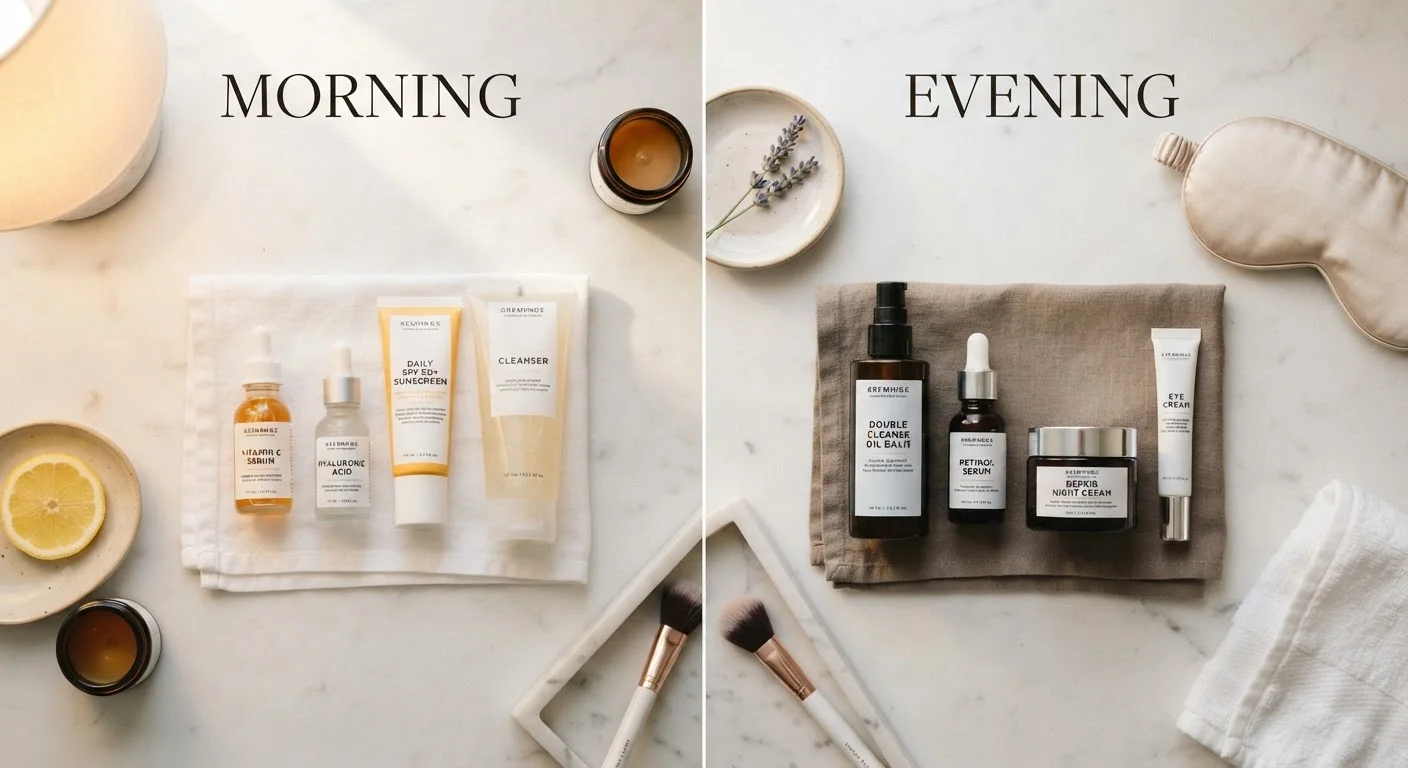
Photo: SummarizedReads.net | Just Read It! editorial
—— In This Article
Key Takeaways
- Morning routines focus on protection from UV, pollution, and environmental stress.
- Evening routines prioritize repair, renewal, and deeper ingredient absorption.
- Some active ingredients - like retinol - should only be used at night due to sun sensitivity.
- SPF is non-negotiable in the morning and should always be the final step.
- You don't need separate product lines - understanding purpose lets you work with fewer products.
Why Morning and Evening Skin Needs Are Genuinely Different
Your skin isn't static. During the day, it acts as a barrier - fending off UV radiation, pollution, and environmental oxidative stress. At night, it shifts into repair mode, ramping up cell turnover and rebuilding moisture reserves. Dermatologists commonly describe this as the skin's circadian rhythm, and it's the core reason AM and PM routines should differ in composition and intent.
This isn't marketing. Research into skin biology shows that transepidermal water loss (TEWL - the rate at which water evaporates through the skin's surface) is higher at night, and skin cell division peaks in the evening hours. That context shapes which ingredients make sense when. See our guide to hydration vs. moisturisation for a deeper look at how the skin manages water differently across the day.
~2x
Higher overnight cell turnover rate
Skin cell division has been observed to be roughly twice as active at night compared to daytime, according to dermatology literature on circadian skin biology.
80%
Of UV exposure comes from incidental daily exposure
The Skin Cancer Foundation notes that a large proportion of lifetime UV exposure accumulates through everyday activities, not deliberate sun time - reinforcing daily SPF use.
The Morning Routine: Build a Shield
The AM routine has one non-negotiable priority: protection. Everything else is secondary.
- Cleanser: A gentle, low-stripping formula. In the morning, you're washing off overnight oil and product residue - not heavy grime. Harsh cleansers at this step can compromise the barrier you're about to build.
- Antioxidant serum (optional but worthwhile): Vitamin C is the most studied option. It neutralizes free radicals generated by UV and pollution. Apply before SPF for best effect.
- Moisturizer: Lightweight and non-occluding works well under SPF. If your skin is very dry, look for humectants like glycerin or hyaluronic acid in the formula.
- SPF: The last step, always. Broad-spectrum SPF 30 or higher, applied to face and neck. This step is the single highest-return investment in any skincare routine.
Avoid using retinol, AHAs (alpha-hydroxy acids), or BHAs (beta-hydroxy acids) in the morning - these make skin more photosensitive and lose effectiveness in daylight. If you're short on time, our practical morning routine guide shows how to do this in minutes.
SPF Is Your Lowest-Cost, Highest-Return Step
You don't need an elaborate morning routine to protect your skin effectively. A gentle cleanser and a broad-spectrum SPF 30+ gets you most of the protective benefit. If budget is a constraint, this two-step combination is where to focus first. Everything else - serums, toners, targeted treatments - is additive, not foundational.
The Evening Routine: Let Skin Repair
At night, the barrier is down - and that's actually an opportunity. Skin absorbs actives more readily, and cell turnover is higher, making the PM window the right time for ingredients that drive real change.
- Cleanser (double cleanse if wearing SPF or makeup): Start with an oil-based or micellar cleanser to break down sunscreen and makeup, then follow with your regular cleanser. Skipping this step means active residue sits on skin all night.
- Treatment step: This is where targeted ingredients go - retinol, niacinamide, peptides, or chemical exfoliants (AHAs/BHAs). Not all of these should be used simultaneously; introduce one at a time. See our comparison of retinol and niacinamide to understand which might suit your skin goals.
- Moisturizer: Richer formulas with occlusives - ingredients like shea butter, squalane, or petrolatum - are appropriate at night because they won't feel heavy under makeup and have more time to work.
No SPF at night. It adds no benefit after dark and can interfere with the absorptive environment you're trying to create. For a broader look at whether your current routine is structured correctly, try our skincare routine audit.
| Morning Routine | Evening Routine | |
|---|---|---|
| Primary goal | Protection from UV and environmental damage | Repair, renewal, and deeper absorption |
| Cleanser approach | Single gentle cleanse | Double cleanse if SPF or makeup worn |
| SPF | Required - final step always | Not needed or beneficial |
| Retinol / AHAs / BHAs | Avoid - increase photosensitivity | Ideal time - enhanced absorption |
| Moisturizer weight | Lightweight, non-occluding | Richer, occlusive formulas suitable |
| Antioxidants (e.g. Vitamin C) | Most effective in AM | Less impactful; save for morning |
| Typical step count | 3-4 steps | 3-5 steps |
Common Mistakes That Blur the Line
Most routine confusion comes from a few recurring errors:
- Using retinol in the morning: Retinol degrades in UV light and increases photosensitivity. It belongs in a PM routine, period.
- Skipping SPF because you're indoors: UVA rays penetrate glass. If you're near a window during daylight, SPF is still relevant.
- Applying the same moisturizer twice: A light daytime formula may not provide enough occlusion overnight. Conversely, a thick PM cream under makeup can cause pilling and breakouts.
- Layering too many actives at night: More is not better. Overloading the PM routine is a common cause of irritation. Pick one treatment focus per night if needed.
Understanding what each step is actually doing makes these choices easier. Our cleanser, toner, and moisturiser explainer breaks down the fundamentals if you want to build from the ground up.
This article is for general informational purposes only and does not constitute medical or dermatological advice. Consult a qualified dermatologist or healthcare provider with questions about your specific skin concerns.

Beauty Editorial Team
Beauty Editorial Team is the collective byline for our editorial team and contributor network. Articles published under this byline or an editorial pen name are researched, written, and reviewed according to our editorial standards for clarity, consistency, and independence before publication.
View author profile