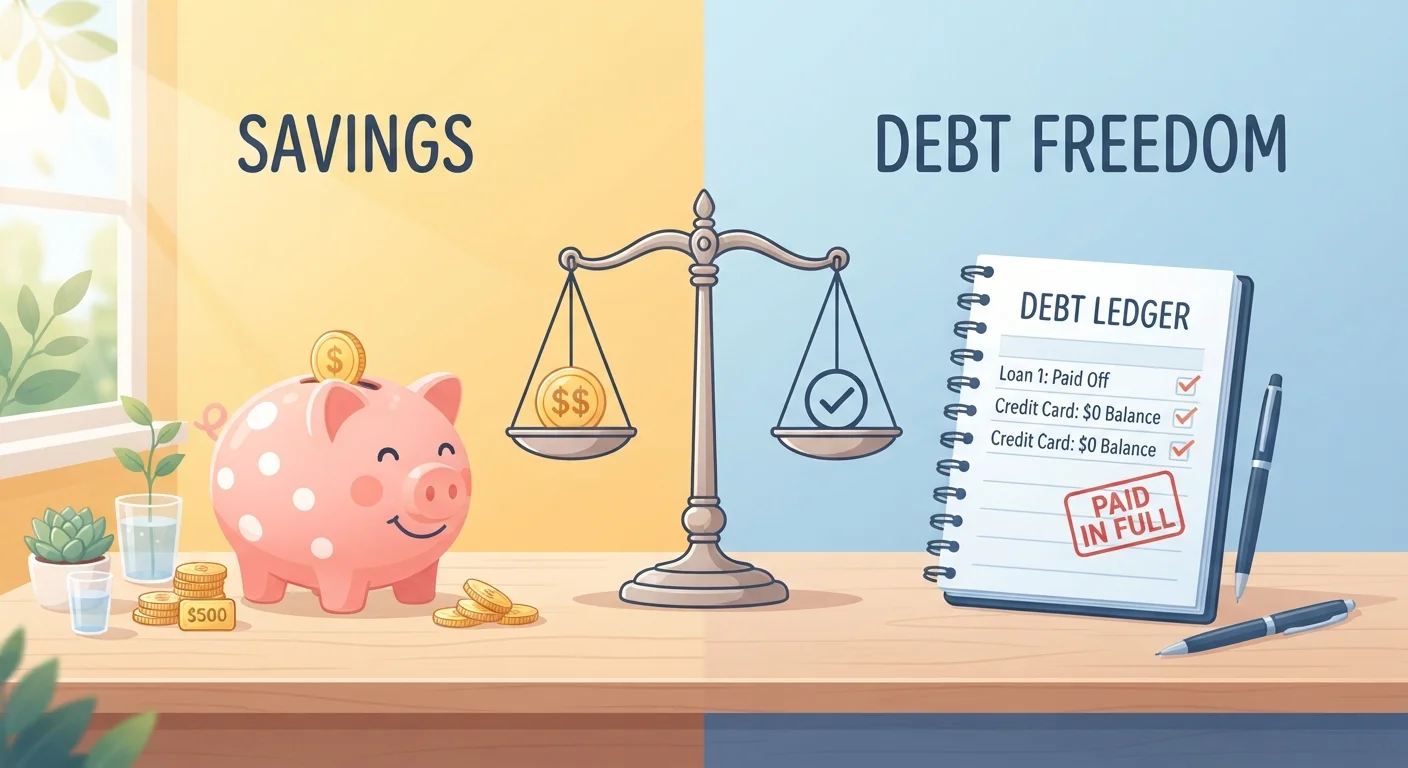
Getting Started With Personal Finance When Debt Is Already in the Picture
A grounded introduction to savings habits, debt mechanics, and priority-setting for anyone beginning their financial journey with existing obligations.

Photo: SummarizedReads.net | Just Read It! editorial
—— In This Article
Key Takeaways
- Carrying debt while starting to manage your finances is the norm, not the exception.
- Knowing the interest rate, type, and minimum payment of each debt is the essential first step.
- A basic budget helps you see where money actually goes before you decide how to redirect it.
- Building a small emergency fund alongside debt repayment often prevents the cycle of going deeper into debt.
- Debt repayment strategies like the avalanche and snowball methods offer different psychological and financial trade-offs.
- Consulting a licensed financial professional is advisable before making major decisions about debt or savings.
Why Debt Doesn't Mean You're Starting Behind
Most people who decide to take control of their money do so with some debt already in the picture - a student loan, a credit card balance, a car payment, or some combination. That's not a failure state. It's the normal starting condition for the majority of American adults.
What matters most at the beginning isn't the size of the debt; it's the decision to look at it clearly and build a plan around it. The financial habits you build now - tracking spending, making intentional decisions about where money goes - are exactly as valuable whether your balance is $800 or $18,000.
Debt does add complexity to personal finance. It creates a fixed obligation each month, it costs money in interest, and it can generate real stress. For a grounded look at how emotions shape financial decision-making, our article on psychological factors behind debt is worth reading alongside this guide. But complexity isn't the same as hopelessness, and getting started - even imperfectly - is the most important move.
Understanding Your Debt Before You Plan Around It
Before you can make good decisions, you need a clear picture. Pull together every debt you carry and note three things for each: the current balance, the interest rate (APR), and the minimum monthly payment.
APR (Annual Percentage Rate)
The yearly cost of borrowing money, expressed as a percentage. A higher APR means debt costs more each month you carry a balance.
Minimum payment
The smallest amount a lender requires you to pay each month to keep the account in good standing. Paying only this amount usually means most of the payment covers interest, not principal.
Principal
The actual amount you borrowed, separate from the interest charges. Reducing the principal faster reduces the total interest you'll pay over time.
Credit utilization ratio
The percentage of your available credit card limit that you're currently using. A lower ratio generally helps your credit score.
Discretionary income
The money left over after paying for essential expenses like rent, utilities, food, and minimum debt payments - what you actually get to allocate freely.
Debt avalanche
A repayment strategy where you direct extra payments toward the debt with the highest interest rate first, reducing the total amount you pay in interest over time.
This inventory matters because not all debt is equal. A federal student loan at 5% APR behaves very differently from a store credit card at 28% APR. High-interest debt costs you money every month you carry it - the interest accrues and compounds, meaning you pay interest on interest. Lower-interest debt is still a real obligation, but it's generally less financially destructive to manage more slowly.
Once you have this list, you'll know exactly what your debt is costing you - and that knowledge directly shapes your strategy.
Building a Budget That Accounts for Debt
A budget isn't a restriction - it's a map of where your money actually goes so you can decide where you want it to go. The complete budgeting overview on this site walks through frameworks in detail, but the core is straightforward: total your monthly take-home income, list every fixed expense (including all minimum debt payments), then account for variable spending like groceries and transportation.
What's left after essentials is your discretionary income - the money available for extra debt payments, savings, and flexible spending. The widely referenced 50/30/20 rule suggests roughly 50% of take-home income for needs, 30% for wants, and 20% for savings and debt repayment beyond minimums. Treat that as a rough orientation, not a rigid rule, since real-life budgets rarely land cleanly in those buckets.
Track For One Month Before Cutting
Before making any dramatic budget changes, spend one full month simply recording what you spend - every subscription, every coffee, every impulse purchase. Real data about your actual habits is far more useful than an idealized budget built on guesses. Most people are surprised by at least one spending category once they see the numbers.
A monthly financial audit checklist can help you stay on top of changes - income shifts, new expenses, or progress on balances - so your budget stays current rather than becoming outdated.
Should You Save or Pay Down Debt First?
This question comes up constantly, and the honest answer is: usually both, in proportions that depend on your specific situation. Focusing only on debt repayment while keeping zero savings tends to backfire - a single unexpected car repair or medical bill can force you to take on new high-interest debt, erasing your progress.
A practical starting approach: build a small starter emergency fund first - even $500 to $1,000 set aside in a separate account - then direct extra money aggressively toward high-interest debt. Once that debt is cleared, you can expand your emergency fund and shift toward broader savings goals.
For debt repayment order, two common methods are:
- Debt avalanche: Pay minimums on everything, then put extra money toward the highest-interest debt first. Minimizes total interest paid over time.
- Debt snowball: Pay minimums on everything, then target the smallest balance first regardless of rate. Generates quicker wins that can sustain motivation.
Neither is universally superior - the right choice depends on your numbers and your psychology. Our guide on balancing emergency funds and debt repayment explores this trade-off in more depth. For decisions that are specific to your situation, consulting a licensed financial professional is strongly recommended.
Once you're ready to set longer-term targets, structuring savings goals alongside debt repayment offers practical guidance on keeping both tracks moving.
Common Pitfalls When Starting Out With Debt
A few patterns consistently derail people who are genuinely trying to improve their finances:
Avoid 'Avalanche' Thinking on All Debt Equally
Not every debt deserves aggressive payoff treatment. Funneling every spare dollar at a low-interest student loan while carrying high-interest credit card debt can cost you significantly more in the long run. Always prioritize by interest rate, not by which balance feels most psychologically uncomfortable to see.
- Ignoring the debt inventory. Vague awareness of debt is not a plan. Not knowing your interest rates means you can't prioritize effectively.
- Treating minimum payments as the finish line. Minimum payments keep accounts current, but they extend repayment timelines dramatically and significantly increase total interest paid.
- Delaying budgeting until debt is gone. Budgeting is how you find the money to pay down debt faster. The two are inseparable, not sequential.
- Saving zero while repaying debt. Without any financial cushion, a single unexpected expense can push you back into debt - often at a higher rate.
The broader financial picture - credit, debt psychology, and building longer-term habits - is covered in related guides including budgeting basics and building a credit history from scratch.
This article is for general informational and educational purposes only and does not constitute personalized financial, tax, or legal advice. Consult a qualified, licensed financial professional before making decisions about your specific financial situation.
Frequently Asked Questions

Finance Editorial Team
Finance Editorial Team is the collective byline for our editorial team and contributor network. Articles published under this byline or an editorial pen name are researched, written, and reviewed according to our editorial standards for clarity, consistency, and independence before publication.
View author profile