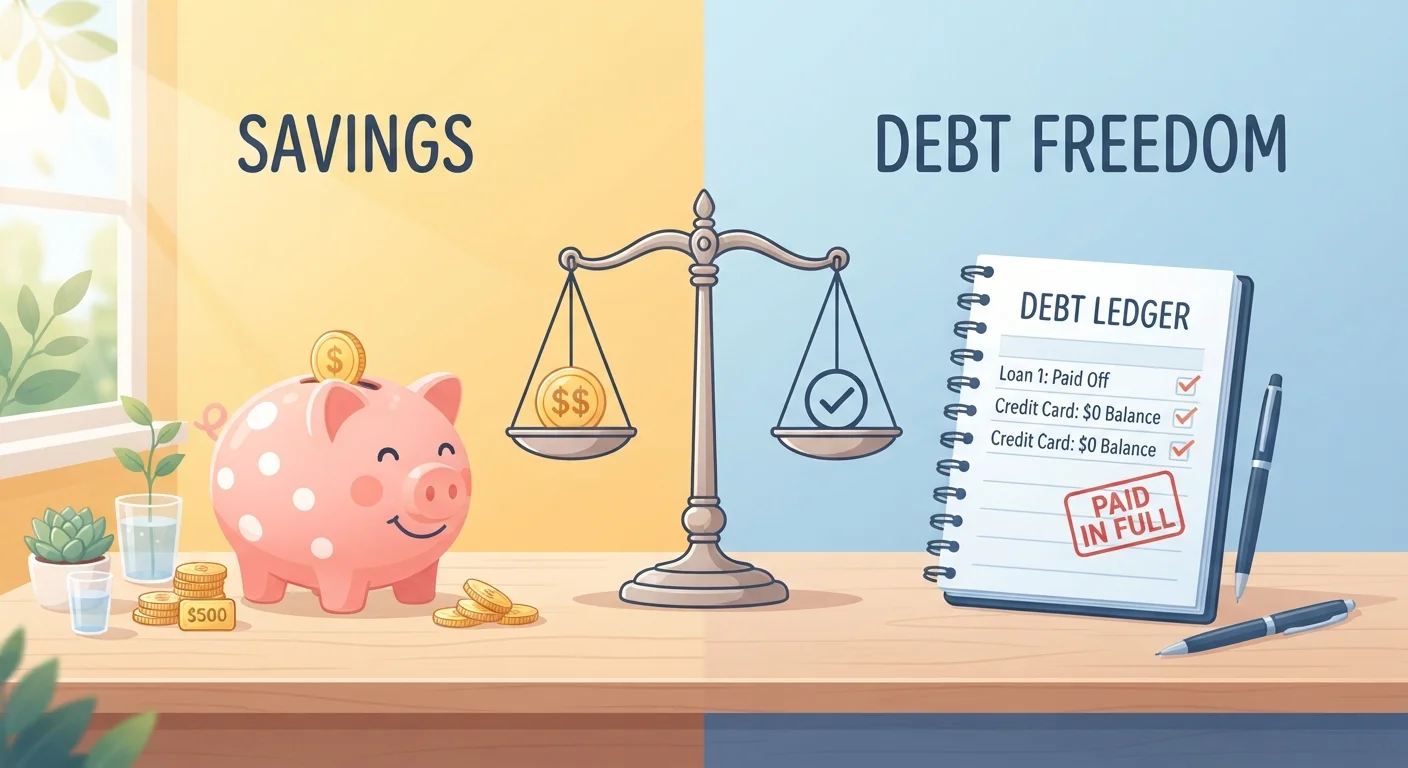
Emergency Funds and Debt Repayment: Finding the Right Balance
Should you prioritise an emergency cushion or paying down debt faster? A look at the reasoning behind common approaches to this dilemma.

Photo: SummarizedReads.net | Just Read It! editorial
—— In This Article
Key Takeaways
- A small starter emergency fund - often cited as $500 to $1,000 - can prevent new debt when unexpected costs arise.
- High-interest debt typically costs more over time than a savings account earns, which informs the case for prioritizing repayment.
- A split approach - saving a modest cushion while making debt payments - works for many households and is not an all-or-nothing choice.
- Your debt interest rate is the single most useful number when deciding how aggressively to save versus repay.
- Consult a licensed financial adviser before making major changes to your debt or savings strategy.
Why This Decision Is Genuinely Difficult
The tension between building an emergency fund and paying down debt is real - and it's not just a matter of math. Emotionally, carrying debt feels urgent. Practically, having no financial buffer means one car repair or medical bill can push you deeper into debt than you started. Both pressures are legitimate.
The core issue is that most personal finance advice treats these goals as sequential: get out of debt, then save. But for many households, that sequence can take years, leaving people exposed to financial shocks the entire time. Doing both at once is often more resilient than picking one path absolutely.
Understanding the reasoning behind each approach - rather than just following a rule - puts you in a better position to make a decision that fits your actual situation.
The Three Main Approaches Compared
There are three broad strategies most financial frameworks describe when someone is managing both debt and an absent or inadequate emergency fund.
| Debt-First | Emergency Fund First | Split Approach | |
|---|---|---|---|
| Best suited for | High-interest debt holders with stable income | Variable income or job insecurity | Moderate debt rates, tight cash flow |
| Interest cost impact | Reduces fastest | Slower reduction | Gradual reduction |
| Resilience to shocks | Lower without any buffer | Higher once fund is built | Moderate throughout |
| Psychological pressure | High - no safety net | Lower once cushion exists | Balanced, manageable |
| Time to full emergency fund | Delayed until debt is cleared | Achieved first | Gradual, concurrent |
| Complexity to manage | Simple - one focus | Simple - one focus | Requires careful budgeting |
The debt-first approach argues that high-interest debt is effectively a guaranteed negative return - every dollar you owe at 20% APR costs you 20 cents annually. Parking money in a savings account earning far less means the math doesn't favor saving aggressively. This logic is strongest when interest rates on the debt are high.
The emergency-fund-first approach prioritizes a buffer - commonly three to six months of essential expenses, though many advisers suggest starting with a smaller target like $500 to $1,000 - before making extra debt payments. The reasoning: without a cushion, any unexpected expense gets charged back to credit, undoing your repayment progress.
The split approach allocates extra cash flow to both goals simultaneously - for example, directing a portion to a savings account while still making more than the minimum payment on debt. This is slower on both fronts but reduces vulnerability. Setting realistic milestones for both tracks helps keep this strategy from feeling aimless.
The Number That Matters Most: Your Interest Rate
Your debt's interest rate is the clearest signal for how to weight your priorities. A rough framework used by many financial educators:
- Above 10% APR: Extra payments toward debt likely outperform saving beyond a minimal buffer, because the interest cost exceeds most savings yields.
- Between 5-10% APR: The split approach makes sense - aggressively saving and aggressively repaying are closer in financial value.
- Below 5% APR: Building savings more assertively may be reasonable, since low-rate debt is less financially damaging over time.
This is general educational guidance, not a formula guaranteed to fit every situation. Tax implications, loan terms, and income variability all matter. A licensed financial adviser can assess the full picture for your circumstances.
Start With Your Debt's APR
Before deciding how much to save versus repay, pull out your most recent statements and note the annual percentage rate (APR) on each debt. That single number tells you more about your real cost than any general rule. If you have multiple debts at different rates, list them from highest to lowest - this is the foundation of the debt avalanche method and a useful starting point for any prioritization decision.
For anyone evaluating how their debts stack up against each other, the debt avalanche and debt snowball methods offer two structured frameworks for sequencing repayment.
What Happens When You Have No Buffer at All
Skipping an emergency fund entirely to maximize debt repayment carries a specific risk: one unplanned expense can stall or reverse months of progress. A job disruption, medical bill, or home repair paid on a credit card may add more debt than the extra payments removed.
Missing even one payment can trigger late fees, penalty interest rates, and credit score damage that compounds the original problem. A minimal buffer - even a few hundred dollars set aside in a separate account - acts as a firewall between your repayment plan and real-world disruptions.
Financial stress also has measurable effects on decision-making and wellbeing. If you're interested in how money anxiety intersects with mental health, the mental well-being hub covers practical strategies for managing financial stress alongside everyday pressures.
Putting a Plan Into Practice
Regardless of which approach fits best, a few practical principles apply across all three strategies:
- Always cover minimum payments first. Missing scheduled debt payments creates costs - fees, credit damage - that outweigh any short-term savings gain.
- Treat your emergency fund as non-negotiable once set. Define a target, automate contributions, and resist the urge to redirect that money toward debt when you feel impatient.
- Reassess regularly. A monthly financial audit helps you catch when your income, interest rates, or expenses shift - and adjust your split accordingly.
- Understand your budget philosophy. Whether you prefer a pay-yourself-first or traditional budgeting model affects how you structure these priorities in practice.
This article is for general informational and educational purposes only and does not constitute personalised financial, investment, tax, or legal advice. Speak with a qualified, licensed financial professional before making decisions specific to your financial situation.

Finance Editorial Team
Finance Editorial Team is the collective byline for our editorial team and contributor network. Articles published under this byline or an editorial pen name are researched, written, and reviewed according to our editorial standards for clarity, consistency, and independence before publication.
View author profile