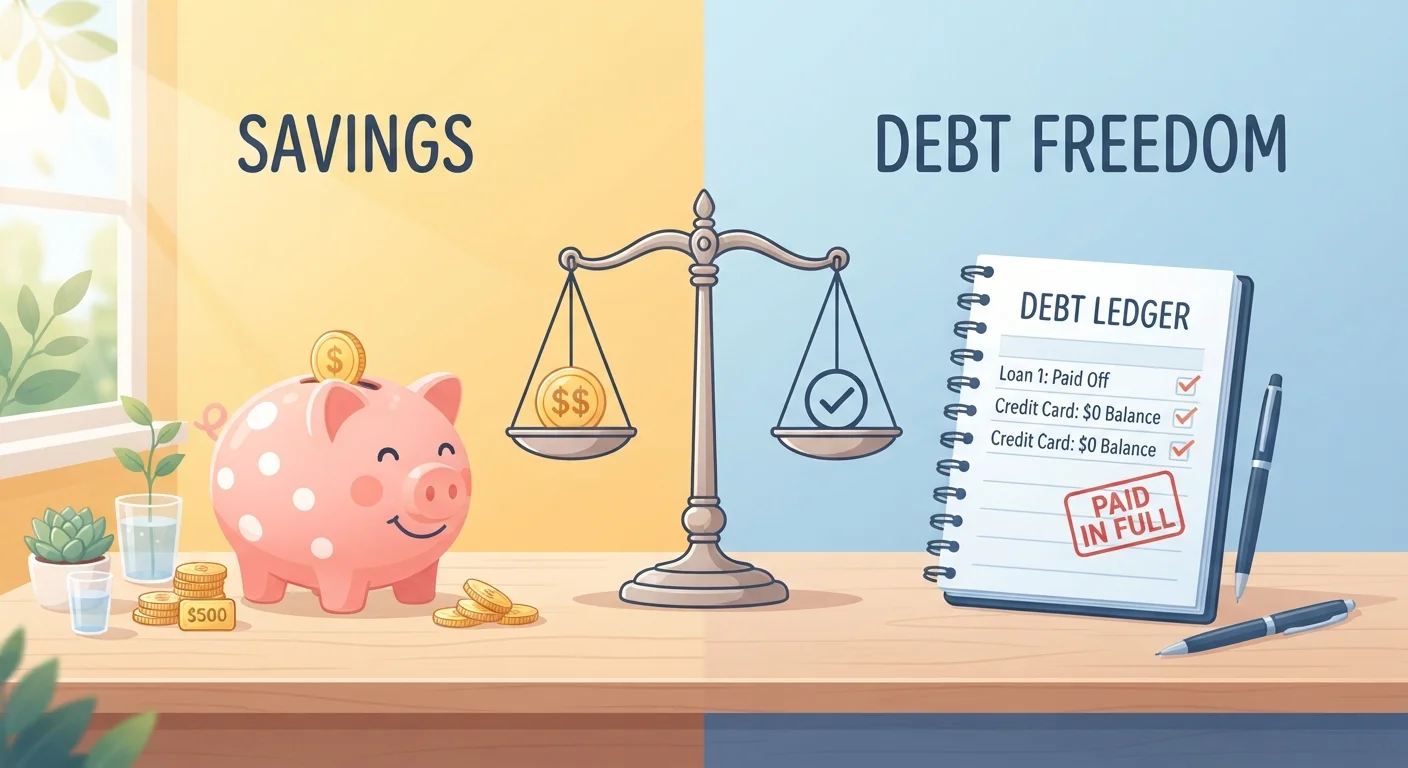
Key Terms Every Debt and Savings Conversation Uses
A plain-language reference for terms like APR, compound interest, liquidity, and amortisation — the vocabulary of everyday personal finance.

Photo: SummarizedReads.net | Just Read It! editorial
—— In This Article
Why This Vocabulary Matters
When you're trying to pay down debt while also building savings, you'll run into a consistent set of terms - in loan disclosures, bank statements, and every piece of financial advice you read. If those terms are fuzzy, the decisions built around them will be too.
This reference covers the core vocabulary used in debt and savings conversations. It's organized by concept rather than alphabetically, so related terms sit next to each other. Bookmark it and use it alongside a grounded introduction to managing debt and savings.
APR (Annual Percentage Rate)
The yearly cost of borrowing expressed as a percentage, including interest and certain fees but not compounding. Used to compare the cost of loans and credit cards.
APY (Annual Percentage Yield)
The actual annual return on a deposit account after compounding is applied. A higher APY means more earnings on savings over time.
Amortization
The gradual payoff of a loan through regular scheduled payments that cover both interest and principal. Early payments in an amortized loan are weighted more heavily toward interest.
Compound Interest
Interest calculated on both the original principal and any previously accumulated interest. It accelerates growth in savings accounts and increases costs on unpaid debt balances.
Liquidity
How easily an asset can be converted to cash without significant loss. Savings in a checking account are highly liquid; funds tied up in a CD with penalties are less so.
Debt-to-Income Ratio (DTI)
Your total monthly debt payments divided by your gross monthly income. Lenders use DTI to evaluate how much additional debt a borrower can realistically handle.
Credit Utilization
The share of your available revolving credit currently in use, expressed as a percentage. It is one of the more influential factors in credit score calculations.
Opportunity Cost
The value of the next-best option you forgo when making a financial choice. For example, every dollar used to pay down debt is a dollar not earning interest in savings.
Interest, Rates, and How Costs Accumulate
Interest is the engine behind both debt growth and savings growth - and its mechanics are worth understanding precisely. A few key distinctions:
- Simple vs. compound interest: Simple interest is calculated only on your original principal. Compound interest is calculated on the principal plus any accumulated interest, meaning balances can grow faster than most people expect. See how compound interest works on both savings and debt for a full breakdown.
- APR vs. APY: APR (Annual Percentage Rate) reflects the yearly cost of borrowing, including fees but without compounding. APY (Annual Percentage Yield) reflects actual annual earnings or cost after compounding is applied. When comparing savings accounts, use APY. When comparing loans, scrutinize APR.
- Fixed vs. variable rates: A fixed rate stays the same for the life of a loan or agreement. A variable rate can change, typically tied to a benchmark like the federal funds rate. Variable rates introduce uncertainty into repayment planning.
43%
DTI threshold commonly used in loan decisions
A debt-to-income ratio above 43% is a frequently cited benchmark at which many lenders become more cautious about approving additional borrowing.
3-6x
Months of expenses recommended in an emergency fund
Financial planning frameworks commonly recommend this range as a baseline buffer before prioritizing aggressive debt repayment or investment.
Debt Mechanics: What You Owe and How It Moves
Understanding how debt balances change over time helps you see where your money actually goes each month.
- Principal: The original amount borrowed, before any interest accrues.
- Amortization: The process of paying off a loan through scheduled payments that cover both interest and principal. Early in an amortized loan, most of each payment goes toward interest. Over time, more goes toward principal - which is why extra early payments can save a significant amount.
- Minimum payment: The smallest amount a lender requires each billing cycle to keep an account in good standing. Paying only minimums on high-interest debt means most of your payment covers interest, not balance reduction.
- Debt-to-income ratio (DTI): Your total monthly debt payments divided by your gross monthly income. Lenders use DTI to assess creditworthiness; a lower ratio generally signals less financial strain. A DTI above 43% is commonly considered a threshold for loan eligibility concerns.
When you're ready to build a repayment strategy around these mechanics, the debt avalanche and debt snowball methods are two well-established frameworks to consider.
Savings Terms That Shape Your Strategy
Savings decisions involve their own vocabulary. Here are the terms that come up most often when weighing where to keep money and how accessible it should be.
- Liquidity: How quickly and easily an asset can be converted to cash without significant loss in value. A checking account is highly liquid. A certificate of deposit (CD) with an early-withdrawal penalty is less liquid. When building an emergency fund, liquidity matters more than yield.
- Emergency fund: A dedicated cash reserve - commonly suggested to cover three to six months of essential expenses - held in a liquid account. Its purpose is to absorb unexpected costs without forcing you to borrow.
- Opportunity cost: What you give up by choosing one option over another. Paying extra toward debt reduces interest costs, but the same dollars won't be earning interest in savings. Neither choice is universally right; the comparison depends on your specific rates and goals.
For a practical framework that brings these trade-offs together monthly, the monthly financial audit checklist is a useful tool.
| Common emergency fund target | 3-6 months of essential expenses (Widely cited personal finance guideline) |
| Suggested credit utilization ceiling | Below 30% (General credit-scoring guidance) |
| DTI threshold often flagged by lenders | 43% (Common mortgage lending benchmark) |
| Rate type affecting budgeting predictability | Fixed (stable) vs. Variable (can change) |
Credit Terms Worth Knowing
Credit intersects with both debt and savings - your credit profile affects the rates you're offered and the accounts you can access. The Credit Explained hub goes deeper, but these are the foundational terms.
- Credit utilization: The percentage of your available revolving credit (like credit cards) that you're currently using. Lower utilization generally correlates with stronger credit scores. Many sources suggest keeping it below 30%, though lower is typically better.
- Credit score: A numerical summary of your credit history, used by lenders to assess risk. Scores are calculated by credit bureaus using factors including payment history, utilization, length of credit history, and recent applications.
- Hard inquiry vs. soft inquiry: A hard inquiry occurs when a lender checks your credit as part of a formal application - it can slightly lower your score temporarily. A soft inquiry (like checking your own score) does not affect it.
Understanding these terms helps you read your financial picture more clearly - and supports better decisions about balancing debt repayment with other goals. For broader money management context, the Budgeting Basics hub covers how to build a realistic monthly plan around the numbers you now understand.
This article is for general informational and educational purposes only and does not constitute personalized financial, tax, or legal advice. Consult a licensed financial professional for guidance specific to your situation.

Finance Editorial Team
Finance Editorial Team is the collective byline for our editorial team and contributor network. Articles published under this byline or an editorial pen name are researched, written, and reviewed according to our editorial standards for clarity, consistency, and independence before publication.
View author profile