
Washing Machine vs Washer-Dryer Combo: Which Setup Suits Your Home?
Separate appliances or an all-in-one unit? We break down the real-world trade-offs to help you decide what fits your space and habits.
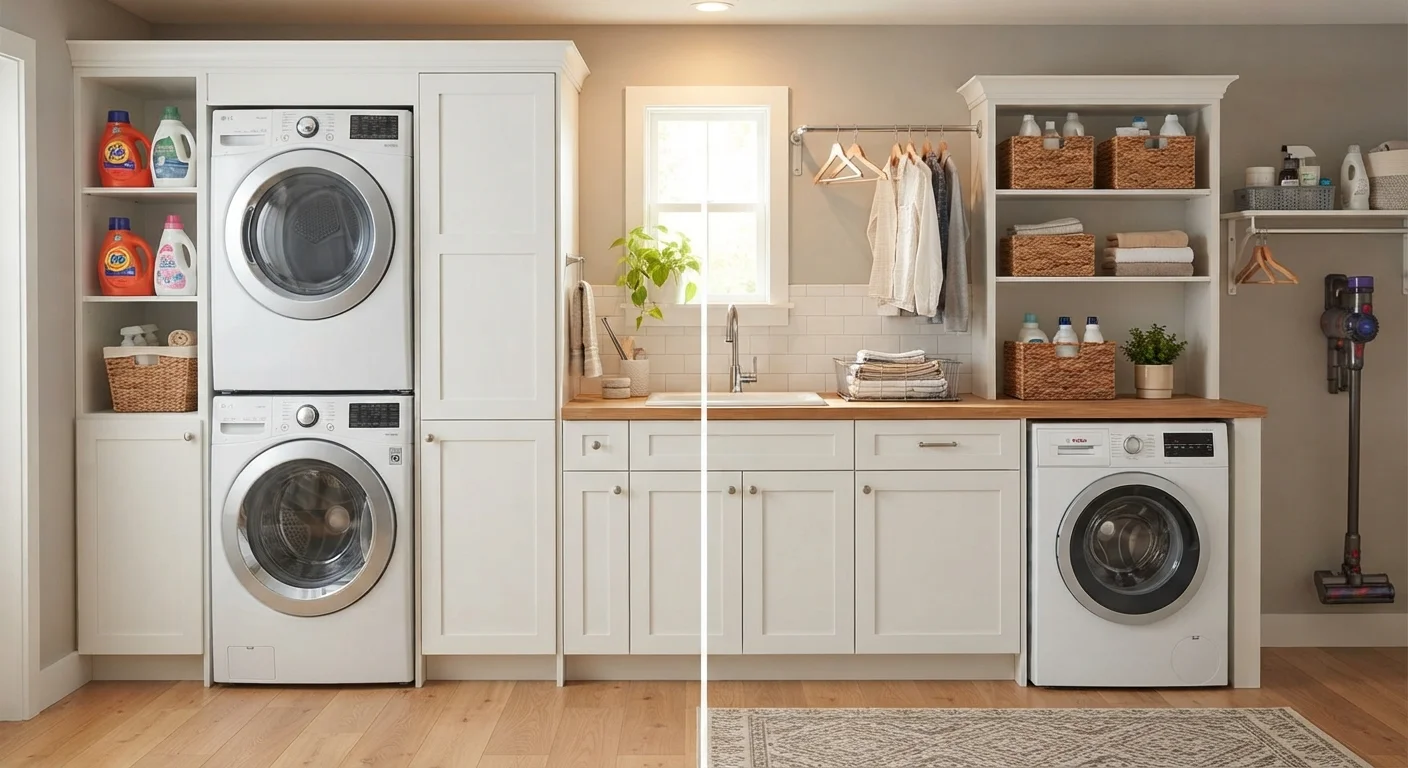
Photo: SummarizedReads.net | Just Read It! editorial
—— In This Article
Key Takeaways
- Separate machines handle larger loads and dry faster, but require significantly more floor space.
- Washer-dryer combos save space but typically have smaller effective drying capacity than their washing capacity.
- Running costs differ: combos often use more energy per drying cycle due to condensation-based drying technology.
- Repair complexity is generally higher for combo units, since one repair can disable both functions.
- The right choice depends primarily on available space, household size, and how often you do laundry.
How Each Setup Actually Works
A separate washing machine and dryer are two distinct appliances, each optimized for one job. The washer agitates clothes in water with detergent, then spins out moisture. The dryer - typically either vented (exhausts hot, moist air outside) or condenser-based (collects moisture internally) - then applies heat to finish the job. Because each machine is dedicated to its task, both can run at full rated capacity simultaneously.
A washer-dryer combo performs both functions inside a single drum. After the wash cycle ends, the same drum transitions to drying - most commonly using condensation drying, which does not require an external vent. This is why combos are so popular in apartments: no ductwork needed. The trade-off is that drying capacity is usually about half the stated wash capacity. A unit advertised as a 2.4 cu. ft. washer may only dry around 1.2 cu. ft. effectively per cycle.
If you're setting up your first home and want a broader framework for prioritizing appliances, see our first-time buyer's appliance orientation for plain-language guidance on where to start.
| Criterion | Separate Washer + Dryer | Washer-Dryer Combo |
|---|---|---|
| Space needed | Requires dedicated laundry area | Fits in a closet or under counter |
| Venting required | Yes, for vented dryers | No (most are ventless) |
| Wash capacity | Typically 4.5-5.5 cu. ft. | Typically 2.0-2.5 cu. ft. |
| Effective dry capacity | Matches wash capacity | Often ~50% of wash capacity |
| Cycle speed (wash + dry) | Simultaneous loads possible | Sequential only; 3-5 hrs per load |
| Upfront cost | Higher (two appliances) | Lower (one unit) |
| Repair complexity | Lower; faults are isolated | Higher; one fault affects both |
| Best suited for | Families, high-volume laundry | Singles, couples, small spaces |
Space, Installation, and Running Costs
Space requirements are the most immediate factor. A stacked washer-dryer pair (one on top of the other) typically occupies a footprint of roughly 27-30 inches wide and 30-32 inches deep - but you still need two units and clearances around them. A combo unit occupies a similar or smaller footprint, fitting comfortably in a closet alcove or under a kitchen counter in some configurations.
Installation for a vented dryer requires an exterior exhaust duct - something many apartments simply lack. Condenser dryers and combo units sidestep this requirement entirely, though they still need a water supply and drain connection.
Running costs deserve careful attention. Vented tumble dryers are energy-intensive. Condensation-based drying - used in most combos and condenser dryers - uses less heat but typically takes longer per cycle, which can mean similar or higher overall energy draw per load. Heat-pump dryers (available as standalone units and in some combo models) are the most energy-efficient drying technology currently available but carry a higher upfront cost.
3-5 hrs
Typical combo wash-and-dry cycle time
Most washer-dryer combos require a sequential wash and dry cycle lasting several hours, compared to roughly 1-1.5 hours for separate machines running simultaneously.
~50%
Effective drying capacity vs. wash capacity in combos
Consumer guidance from appliance manufacturers generally recommends loading combos to around half their stated wash capacity when using the drying function.
27-30 in
Typical combo unit width
Most washer-dryer combo units fit within a standard 27-30 inch wide opening, making them compatible with many apartment closets and kitchen alcoves.
For a fuller picture of what ongoing ownership looks like for a major appliance, our guide on getting the most out of every appliance you own covers maintenance habits that extend performance and life.
Capacity, Performance, and Repair Realities
Laundry throughput is where the setups diverge most sharply. With separate machines, you can wash and dry simultaneously - a full laundry day for a busy household can be completed in a few hours. With a combo, each load must complete both cycles sequentially. A combined wash-plus-dry cycle can take anywhere from three to five hours depending on fabric type and load size, and you cannot dry a second load while the first is still running.
Fabric care is comparable between modern versions of both setups, though some users find that condensation drying in combos produces slightly less even drying results than a dedicated vented dryer. Delicates and woolens are handled well by both when appropriate settings are used.
Repairs and longevity are worth factoring into any long-term calculation. With separate appliances, a fault in the dryer does not affect the washer - you can still do laundry and air-dry while waiting for a repair. With a combo, a mechanical fault can disable both functions at once. Combo units also tend to have more complex internal components, which can mean higher service costs. See our article on repairing vs. replacing a broken appliance if you're weighing whether to service an existing unit.
A Note on Ventless Combo Units
Most washer-dryer combos use condensation drying rather than a traditional vented heat exhaust. This makes them practical for apartments, but condensation drying generally takes longer and can leave clothes feeling slightly damp if overloaded. Always follow the manufacturer's recommended load size for the drying function specifically - not just the washing function - to get the best results.

Home Editorial Team
Home Editorial Team is the collective byline for our editorial team and contributor network. Articles published under this byline or an editorial pen name are researched, written, and reviewed according to our editorial standards for clarity, consistency, and independence before publication.
View author profile